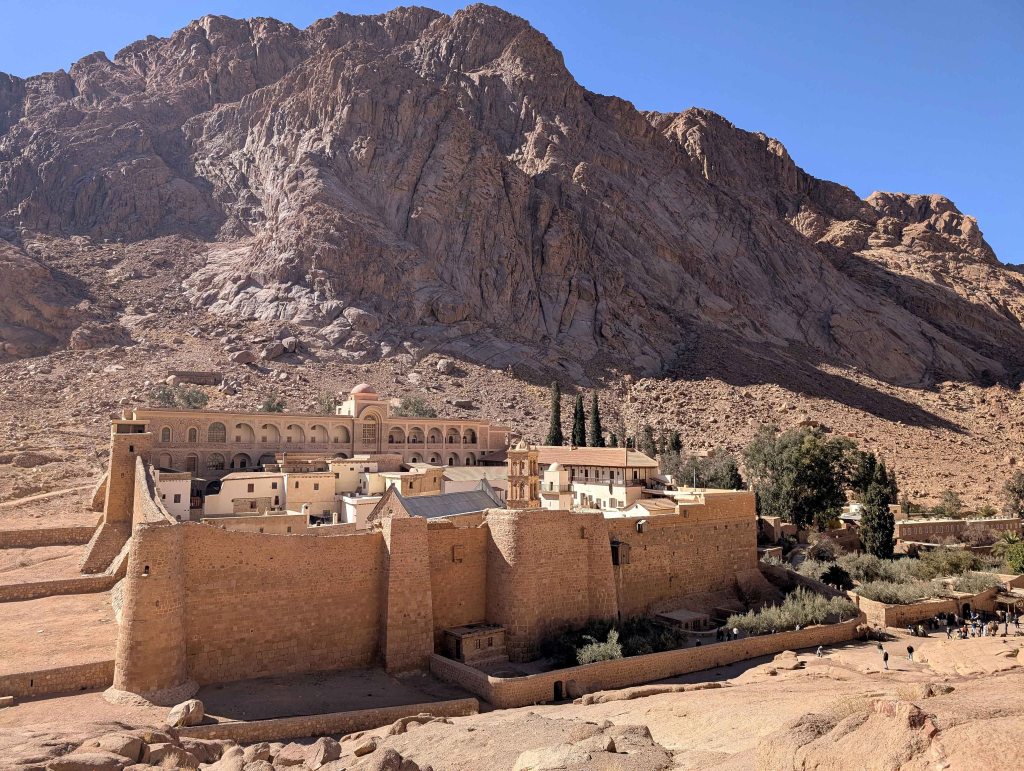
St Catherine’s Monastery, located on the Sinai Peninsula at the crossroads of Africa and Asia, is set within a dramatic landscape of vast deserts and towering mountains. It is widely regarded as the oldest continuously inhabited monastery in the world.
St Catherine’s Monastery, traditionally believed to be built at the site of the Burning Bush, is a Greek Orthodox sanctuary that dates back to 548 AD. For centuries, the monastery has served as a center of spiritual devotion and scholarship. Its remote location in the Sinai Peninsula, coupled with protection from various rulers throughout history, has allowed it to preserve its ancient heritage and remain inhabited. The monastery safeguards centuries-old treasures, including a renowned manuscript library and priceless works of art. In 2002, it was designated a UNESCO World Heritage Site for its exceptional significance to the three major Abrahamic religions: Judaism, Christianity, and Islam.
The monastery was constructed by order of Byzantine Emperor Justinian I around the site traditionally believed to be the location of the Burning Bush, where the Hebrew prophet Moses encountered God. This narrative, central to the Book of Exodus in the Jewish Torah and the biblical Old Testament, as well as Islamic scripture, describes Moses coming upon a bush that is engulfed in flames yet miraculously remains unconsumed. This event signifies Moses’ divine appointment by God to lead the Israelites out of Egypt and into Canaan. The Israelites ended up in Egypt through a chain of events that began when Joseph was sold into slavery by his jealous brothers. He was taken to Egypt, where he eventually rose to power after interpreting Pharaoh’s dreams about an impending famine. To escape the famine, Joseph’s family moved to Egypt and settled in the eastern part of the Nile Delta. Over time, the Tribe of Joseph grew numerous, and a new Pharaoh, fearing their population, enslaved them. This set the stage for Moses to lead the Israelites out of Egypt and into the Promised Land.
Centuries after its founding, the body of St Catherine of Alexandria was reportedly discovered in a nearby cave. A revered Christian martyr and virgin from the early 4th century, she remains one of the most venerated saints in both the Eastern Orthodox and Roman Catholic traditions. According to her hagiography, Catherine was a princess and a renowned scholar, known for her deep understanding of philosophy and theology. Around the age of 14, she converted to Christianity after experiencing a vision of the Virgin Mary and the Child Jesus. Her exceptional intellect and eloquence reportedly led to the conversion of hundreds to Christianity. This brought her into direct confrontation with the Roman emperor Maxentius, whom she boldly denounced for his persecution of Christians. In retaliation, the emperor subjected her to brutal torture and eventually sentenced her to death on a spiked breaking wheel. However, according to legend, the wheel shattered at her touch. She was ultimately beheaded, and, as the story goes, a milk-like substance, rather than blood, flowed from her neck. St Catherine became one of the Fourteen Holy Helpers, a group of saints invoked during the Middle Ages for protection and aid. She is the patron saint of philosophers, students, and unmarried women. Her remains were taken to the monastery that now bears her name, transforming the site into an important pilgrimage destination. Eventually, the monastery was renamed in her honor.
The monastery’s library, established between 527 and 565, is recognized by Guinness World Records as the world’s oldest continuously operating library. It houses the second-largest collection of early codices and manuscripts, along with rare Hebrew and Coptic texts, surpassed only by the Vatican Library. In May 1844 and February 1859, Constantin von Tischendorf, a German biblical scholar, visited the monastery for research and discovered the Codex Sinaiticus, a manuscript dating from the 4th century. At the time, it was the oldest nearly complete manuscript of the Bible. After a meandering journey, the codex now resides in the British Library in London. In February 1892, Agnes Smith Lewis, an English Semitic scholar, uncovered an early palimpsest manuscript of the Gospel in monastery’s library. This manuscript, later known as the Syriac Sinaiticus, remains in the possession of St Catherine’s Monastery. The monastery also holds a copy of the Ashtiname of Muhammad, a document in which the Islamic prophet Muhammad is said to have granted protection and privileges to the monastery and its monks. Additionally, it houses a copy of Mok’c’evay K’art’lisay, a supplementary collection of the Kartlis Cxovreba, dating back to the 9th century. The library still holds many secrets. As of June 2018, more than 160 palimpsests have been identified, bringing the total number of recovered pages to over 6,800. Among the recent discoveries are rare items, including the oldest-known recipe attributed to the Greek physician Hippocrates.
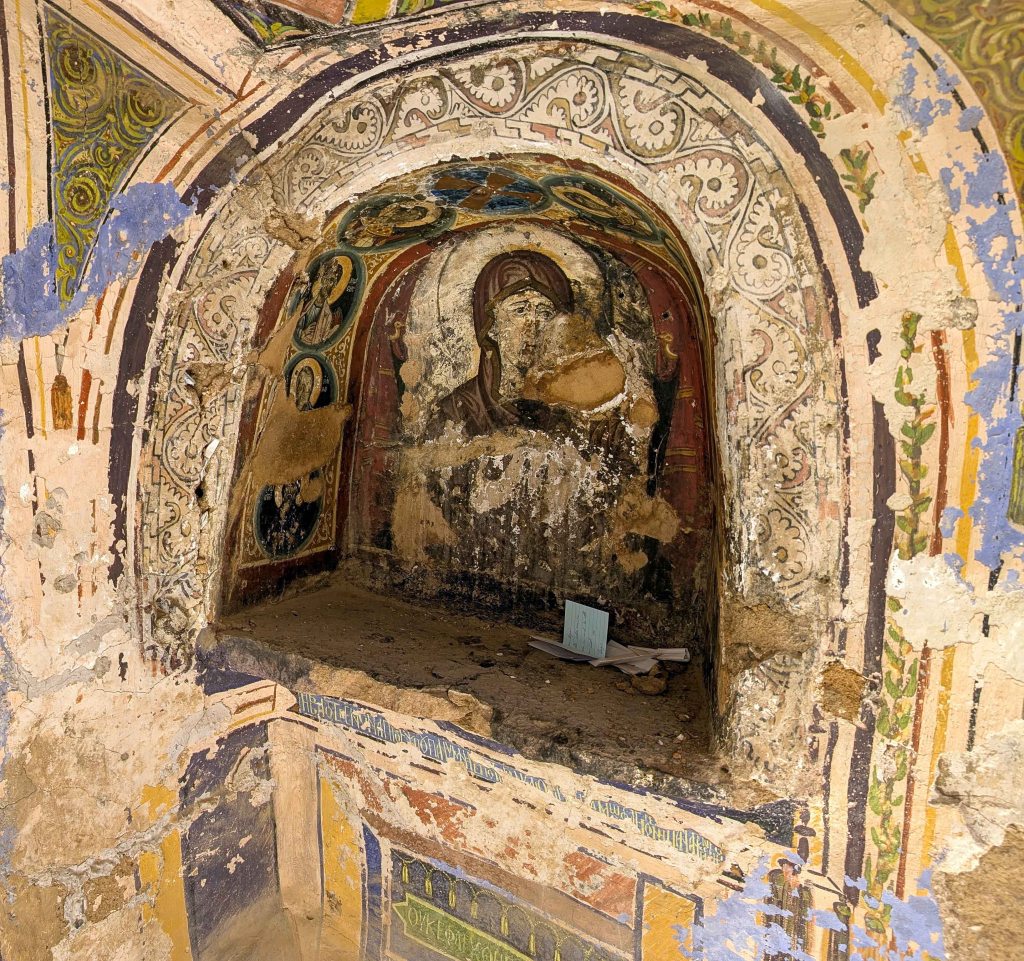
The monastery also houses irreplaceable works of art, including the world’s finest collection of early Christian icons – many created using the encaustic (hot wax) technique – alongside mosaics, liturgical objects, chalices, and reliquaries. Perhaps the monastery’s most prized possession is the earliest known depiction of Jesus asChrist Pantocrator. The monastery also played a significant role in the development of the hybrid style of Crusader art, which blends European and local influences. It retains over 120 icons created in this style, making it the largest collection of its kind in existence.
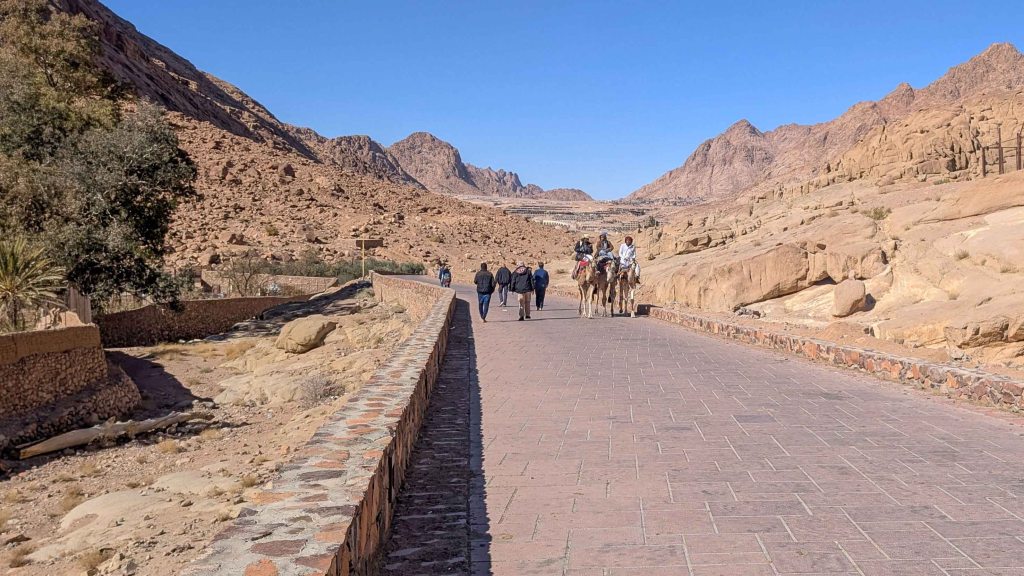
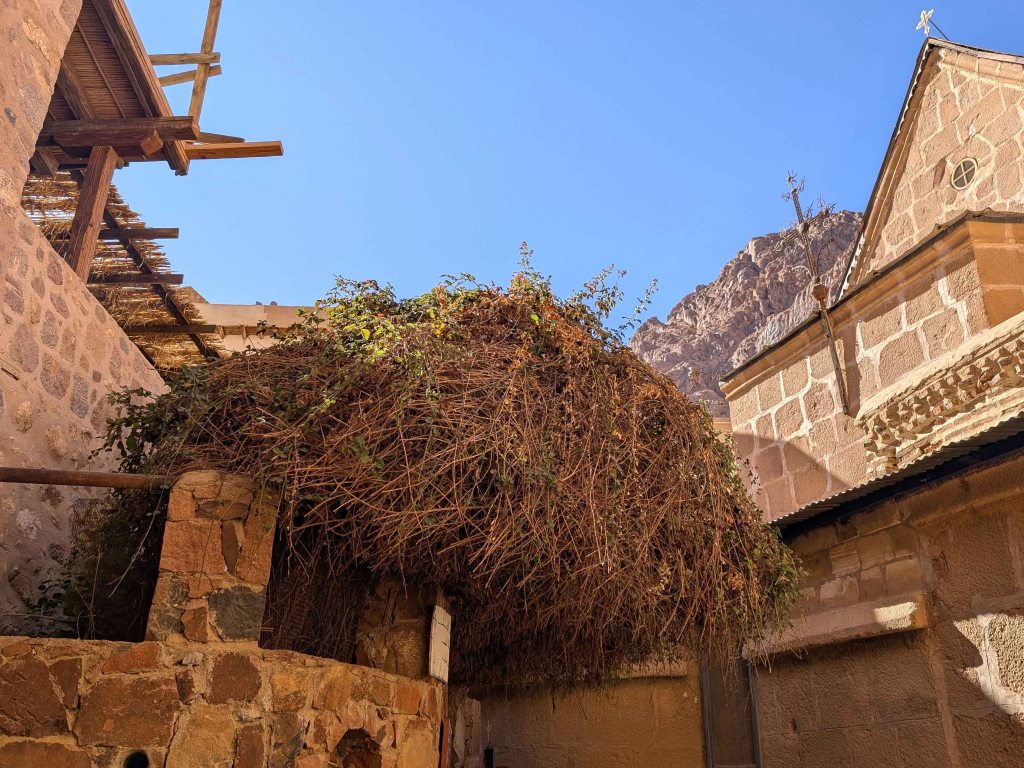
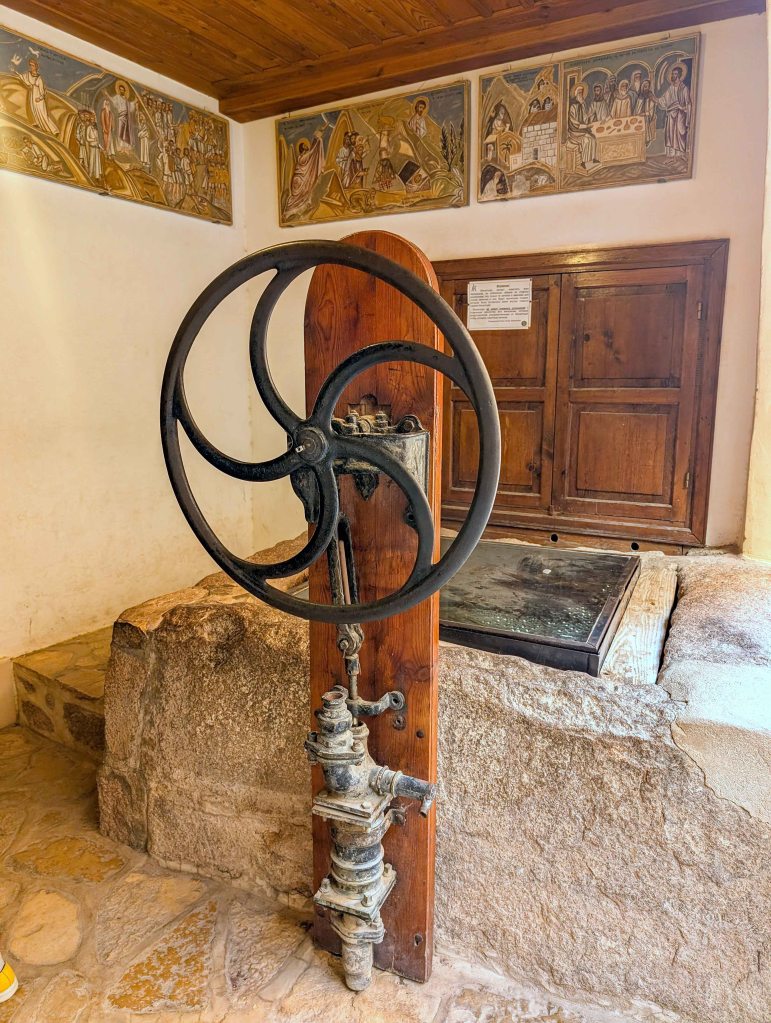
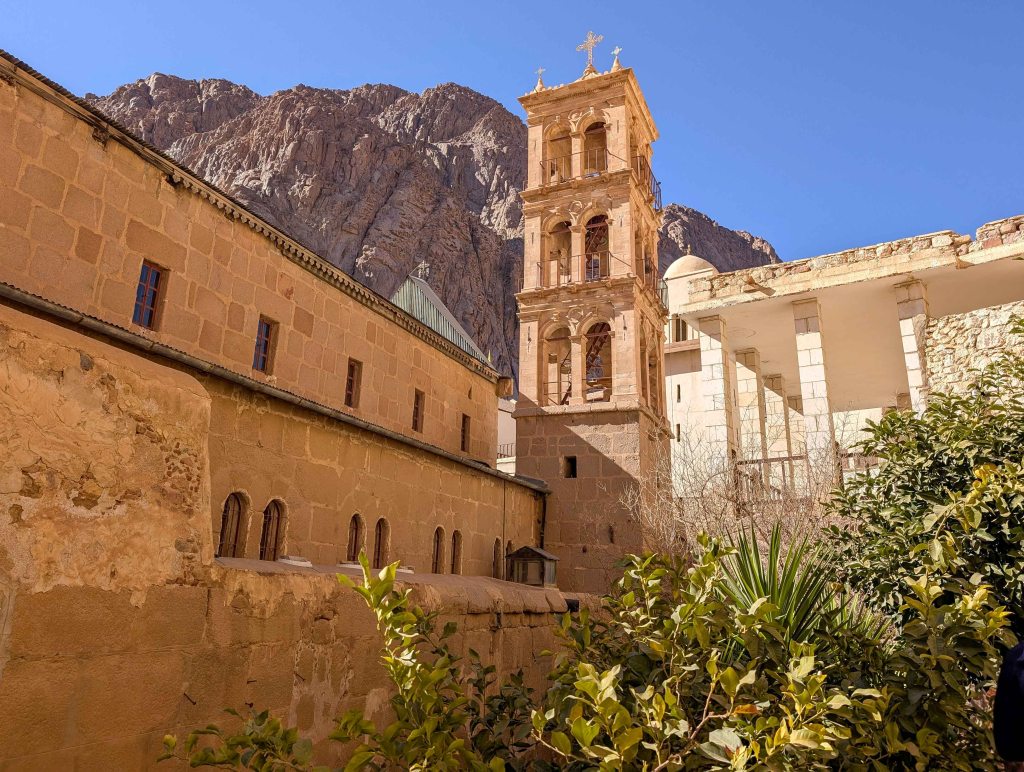
St Catherine’s Monastery is part of a growing complex that includes hotels and shops. To reach the monastery, visitors must walk from the parking lot along a paved path through a valley flanked by barren mountainsides. Inside the massive fortified walls, visitor will find a centuries-old bramble traditionally believed to be the biblical Burning Bush. The monastery also houses the Well of Moses, where Moses is said to have met his future wife, Zipporah. The well remains one of the monastery’s primary sources of water to this day. Visitors can also explore the monastery’s Byzantine church, which is steeped in history and architectural beauty. A small but exceptionally well-curated museum showcases some of the monastery’s treasures, including a selection of icons, ancient manuscripts, and a copy of the Ashtiname of Muhammad. Outside the monastery, Bedouins offer knickknacks and camel rides to visitors. For hikers, the monastery serves as the starting point for treks to nearby mountains, including Mount Sinai, which is traditionally identified as the place where God appeared to Moses and gave him the tablets bearing the Ten Commandments.
 Trespasser-on-Earth