
The mighty King Minos is considered the semi-divine founding father of the Cretan Bronze Age civilization, known as the Minoans.
According to Greek mythology, Minos was the son of Zeus, the god of the sky and justice, who ruled as the king of gods on Mount Olympus, and Europa, a Phoenician princess. Zeus, disguised as a bull, tricked Europa and carried her across the sea from Phoenicia to Crete. From their symbolic union of heaven and earth, three sons were born: Minos, Rhadamanthys and Sarpedon. After Zeus abandoned Europa, she married Asterius, the king of Crete, but the marriage remained childless. Therefore, Asterius adopted Zeus’ sons and made them his heirs. Rhadamanthys, who was a colonizer and lawmaker, alongside Minos, became a judge of the dead in the underworld after his death. Sarpedon, who became the king of Lycia, was a tragic hero of the Trojan War and met his demise at the hands of Patroclus.
After Asterius died, Minos declared himself the ruler of Crete and boasted that his prayers to the gods, however ridiculous they may have seemed, would be answered, thus serving as evidence of his rightful claim to the throne. To substantiate his belief, he built an altar to Poseidon and fervently prayed for a sacrificial bull to emerge from the sea. Miraculously, a magnificent white bull emerged from the water, but Minos was so captivated by its beauty that he spared its life and offered another bull instead. Consequently, the Cretans acknowledged Minos’ authority and accepted his claim to the throne.
Minos was a just and powerful ruler in his earthly realm, although he was merciless towards his enemies. He was also a supreme judge in the underworld and an interlocutor of Zeus in the divine world. Every nine years, Minos would meet with Zeus to engage in conversation, receive education from the god, and obtain orders and permission to rule the earthly realm. To protect Crete from external enemies and preserve internal order, Minos was bestowed the bronze automaton Talos by his father. Forged by the god Hephaestus, Talos would circle the island three times a day, carrying bronze tablets inscribed with divine laws on its shoulders. Residing in Knossos, Minos lived in the opulent palace constructed for him by the ingenious Athenian craftsman Daedalus, who was living in exile in Crete at the time. Under Minos’ leadership, a formidable naval force was established, piracy was eradicated, and he is credited with being the first to exercise control over the Mediterranean.
“[Minos] who was most kingly of mortal kings, and reigned over very many people dwelling round about, holding the sceptre of Zeus wherewith he ruled many.”
Hesiod: Fragments (8th century BC)
“And indeed I saw King Minos there, glorious son of Zeus, sitting, old sceptre in hand and delivering judgement to the dead, who sat or stood all around, putting their cases to him for decision within the House of Hades, to which the gate is wide.”
Homer: The Odyssey (8th century BC)
Minos married Pasiphaë, the daughter of Helios and Oceanid nymph Crete, and they had eight children: Phaedra, Androgeus, Xenodike, Ariadne, Acacallis, Glaucus, Deucalion, and Catreus. Seeking revenge for the insult he received from Minos when the sacrificial bull was replaced, Poseidon caused Pasiphaë to develop an unnatural desire for the magnificent white animal. Driven by her mad lust, Pasiphaë sought the help of Daedalus, who created a lifelike wooden cow covered with cowhide. Pasiphaë concealed herself within the wooden cow, which was so realistic that it deceived the bull and allowed their mating to occur. From this union, the Minotaur was born – a monstrous creature with a human body and a bull’s head. Horrified by his wife’s disgrace, Minos had the Minotaur imprisoned in the underground labyrinth built by Daedalus in Knossos to conceal the creature.
During the Panathenaic festival in Athens, Minos’ son Androgeus emerged victorious over Aegeus, the king of Athens, in every contest. Driven by envy and fear of losing his supreme power, King Aegeus conspired against Androgeus, ultimately leading to his demise. To avenge the death of his son, Minos declared war on Athens. However, when Minos realized that he could not subdue them, he turned to Zeus for help. As a consequence, all of Greece was struck by earthquakes and famine. The kings of various city-states gathered at Delphi to seek guidance from the Oracle, which instructed them to have Aegeus offer a prayer on their behalf. As soon as Aegeus complied, the earthquakes ceased everywhere except in Attica. The Athenians once again consulted the Oracle and were advised to grant Minos whatever he demanded. Consequently, they were compelled to send seven young man and seven young women to Crete every nine years as sacrificial offerings to the Minotaur, as long as the monstrous creature lived. The Athenians obeyed, and the curse was lifted from Attica.
At the end of the nine years, Minos arrived in Athens with a large fleet and demanded an additional 14 youths. Among those sent to Crete to face the Minotaur was Theseus, King Aegeus’ son. Upon their arrival in Crete, Ariadne, Minos’ daughter, fell in love with the handsome Theseus. To help him find his way out of the Labyrinth, Ariadne gave Theseus a ball of thread that she had received from Daedalus. Theseus unraveled the thread as he walked into the Labyrinth, and after slaying the Minotaur, he rewound the thread to find his way out. During his escape from Crete, Theseus took Ariadne with him, but he abandoned her on Naxos while she was sleeping. Furious with Daedalus’ betrayal, Minos imprisoned him and his son Icarus in the Labyrinth. However, Daedalus was resourceful and made wings out of wax and feathers, and they escaped by flying high into the sky. Unfortunately, Icarus ignored his father’s advice and flew too close to the sun, which melted the wax holding his wings together. The young man then plummeted into the sea and drowned.
After seeking refuge at the court of King Cocalus in Camicos, Sicily, the grief-stricken Daedalus found himself pursued by the vengeful Minos, who organized a naval expedition to hunt down the craftsman in hiding. Aware of Daedalus’ cunning nature, Minos needed to devise a plan to flush him out of hiding. Thus, he came up with an impossible challenge – passing a string through a conch shell – which he believed only Daedalus could solve. Intrigued, Daedalus rose to the challenge and solved it by piercing a hole in the tip of the conch shell, smearing it with honey, and tying the thread to an ant. The ant, attracted by the honey, crawled through the spirals of the shell, pulling the thread with it. Delighted by this solution, King Cocalus informed Minos that the riddle had been solved, thus betraying Daedalus. However, unwilling to lose the ingenious craftsman, Cocalus plotted to murder the mighty king instead. Minos met an ignominious end when Cocalus’ daughters killed him in a boiling bath.
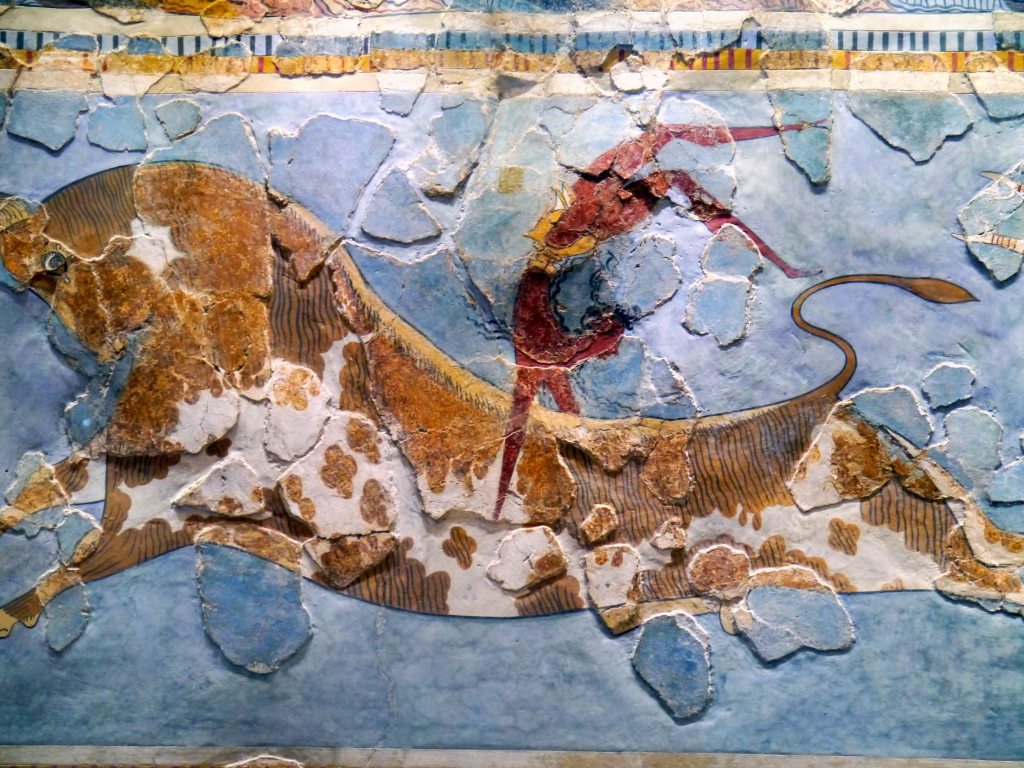
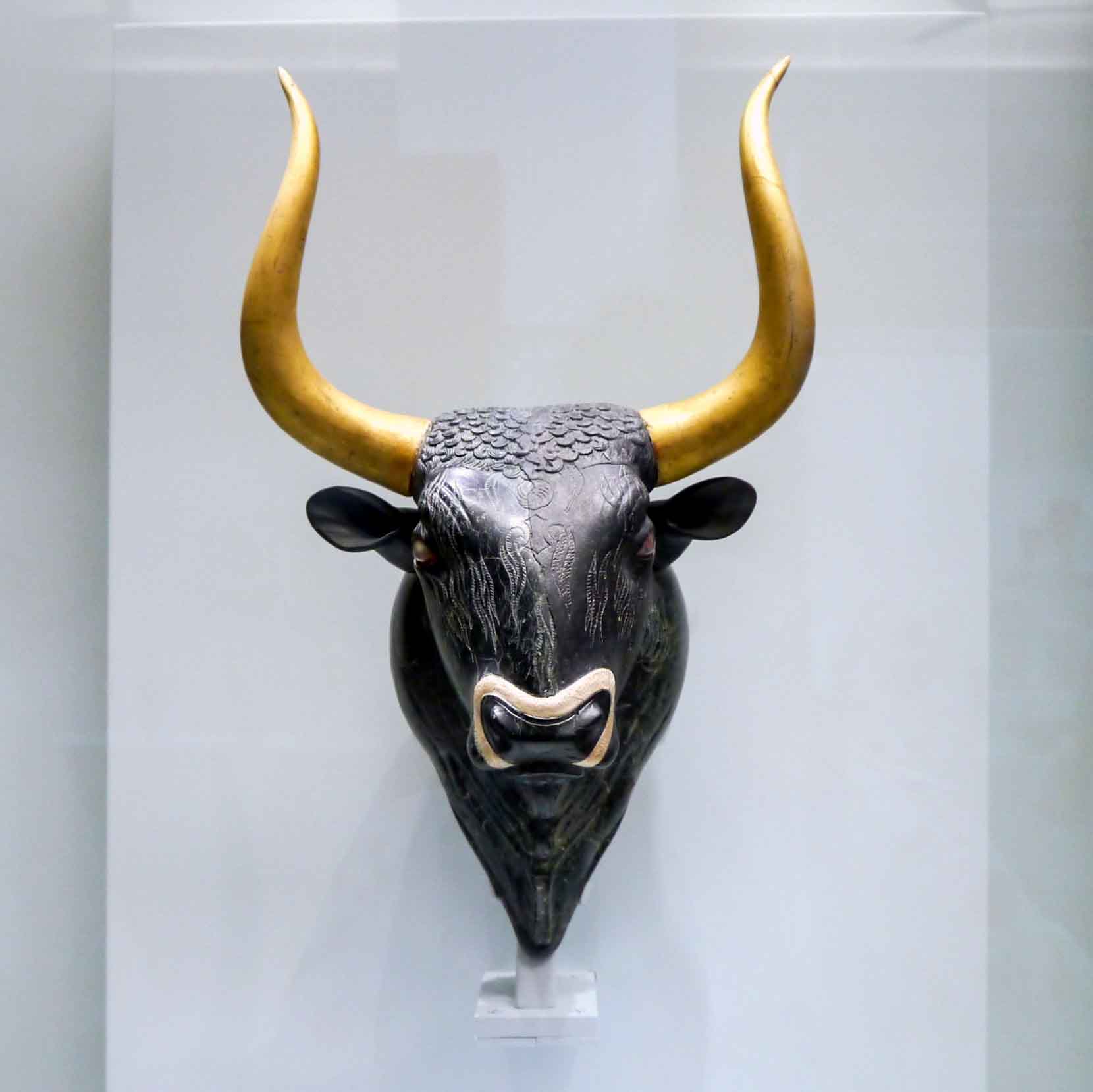


Greek myths have been an inexhaustible source of fascinating themes in art from antiquity to the present day. Minos has been featured in various literary works, such as Homer’s epics, ‘Iliad’ and ‘Odyssey’, and Ovid’s mythological narrative, ‘Metamorphoses’. In Virgil’s epic poem ‘Aeneid’, Minos plays the role of a terrifyingly somber judge in the underworld. Influenced by Virgil, Dante Alighieri portrays Minos as a beast with a giant snake-like tail at the entrance of the Second Circle of Hell in his narrative poem ‘Divine Comedy’. Upon hearing the sins of a soul, Minos decides on the appropriate punishment and assigns the soul to a specific circle by wrapping his tail around his body as many times as the corresponding circle. Michelangelo’s ‘The Last Judgement’ fresco in the Sistine Chapel depicts Minos in this fashion, based on Dante’s vision.
The intricate stories and prominent figures of Greek myths contain a kernel of historical truth. The figure of the just and powerful Minos, who appears in many myths, was a real person from the heroic past for the ancient Greeks. Archeological finds in Crete, particularly the remains of the palace at Knossos believed to be the seat of King Minos, support this notion. The palace indicates a significant center of power and religion, particularly during the peak of the Minoan civilization from 1700 until 1450 BC. The mythical labyrinth, which some hypotheses suggest represents the maze-like Palace of Knossos itself, is mentioned in a Linear B tablet found in Knossos as the location of the ‘priestess of the labyrinth’. The bull, a dominant figure in Cretan myths, is a recurring motif in Minoan art, and the Minotaur appears on seals from Knossos, which is particularly interesting. Additionally, renowned ancient historians of the 5th century BC, such as Herodotus and Thucydides, along with later writers like Strabo, Diodorus Siculus, and Pausanias, mention Minos of Knossos and his dominion over the Mediterranean, as well as the establishment of a network of colonies by the mighty king and his descendants. Archaeological excavations have provided further evidence supporting the historical existence of Minos and his influence in the Mediterranean region. Sites with Minoan cultural characteristics have been discovered in various locations, including the Aegean islands (Kea, Kos, Kythera, Lemnos, Milos, Rhodes, Santorini, Samos, and Samothrace), the Peloponnese (Mycenae and Vapheio), the coast of Asia Minor (Qalna in Syria and Tel Kabri in Israel), and Egypt (Avaris).
Sources
https://www.heraklionmuseum.gr
Diodorus Siculus (1st century BC) The Library of History
Graves, Robert (1955) The Greek Myths: The Complete and Definitive Edition
Kerényi, Károly (1951) Görög mitológia
Plato (5th century BC) Minos
 Trespasser-on-Earth