
Hungarian universities are among the oldest in Europe. The first studium generale was established in Pécs in 1367 on the initiative of King Nagy Lajos
The first universities were organized spontaneously in major cities of Western Europe. The oldest university was founded in Bologna in 1088, followed by the universities of Oxford (1167), Salamanca (1134), and Cambridge (1209). The first universities in Central Eastern Europe were established in the mid-14th century, at the initiative of a ruler and with papal consent. The first university in the region was established in Prague in 1348, followed by the universities of Krakow (1364) and Vienna (1365). The founding charter of a university was issued by the Pope and this document regulated specific rules, rights, and privileges of the universities.
During the medieval period, universities were referred to as studium generale, offering a traditional academic program that covered the seven liberal arts: grammar, logic, rhetoric, arithmetic, geometry, music, and astronomy. After accomplishing these subjects, students could pursue higher faculties such as law, medicine, and theology. However, the teaching of theology was restricted to only a few universities due to the popes’ desire to control theological studies. Teaching at these early universities was conducted in Latin by masters.
The founding charter of the first Hungarian university was issued by a decree of Pope Urban V (papacy: 1362-1370) in 1367 at the request of King Nagy Lajos (reign: 1342-1382). Although the true spiritual father of the establishment of the university was Vilmos Koppenbach (1361-1374), the king’s diplomat and confidant, who was also the Bishop of Pécs. It was founded in Pécs, which was an unusual choice at the time instead of the usual royal seat. According to the papal charter, this decision was influenced by the city’s reputation for cultivating science due to the presence of a Chapter School and four mendicant monasteries that prioritized education. Another reason for establishing the university in Pécs may have been the fact that the diocese of Pécs was one of the most densely populated areas of the Kingdom of Hungary in the Middle Ages. As a result, the Bishop of Pécs enjoyed the second-largest income after the Archbishop of Esztergom.
The University of Pécs was modeled after the University of Bologna. The bishop of Pécs served as the chancellor of the university and exercised jurisdiction over both students and professors. Successful students were awarded with the title of doctor. Regarding the university faculties to be set up, the papal charter declared the creation of a studium generale for the teaching of canon law and civil law. It is unclear whether a medical faculty was established. The pope, like in Krakow and Vienna, did not allow the teaching of theology here either. The most famous professor at the university was Galvano Bethini de Bononia [Bologna], who received his law degree from the prestigious University of Bologna and was one of the greatest canon law experts of his time. He came to teach at the university of Pécs at the invitation of his friend, Bishop Koppenbach and taught there between 1372 and 1374.
The first Hungarian university was closely associated with its founder, Bishop Vilmos, to the extent that it rapidly declined soon after his death. It is believed that it ceased to exist in the 1390s and was almost certainly no longer operational when the second Hungarian university was established in Óbuda in 1395.
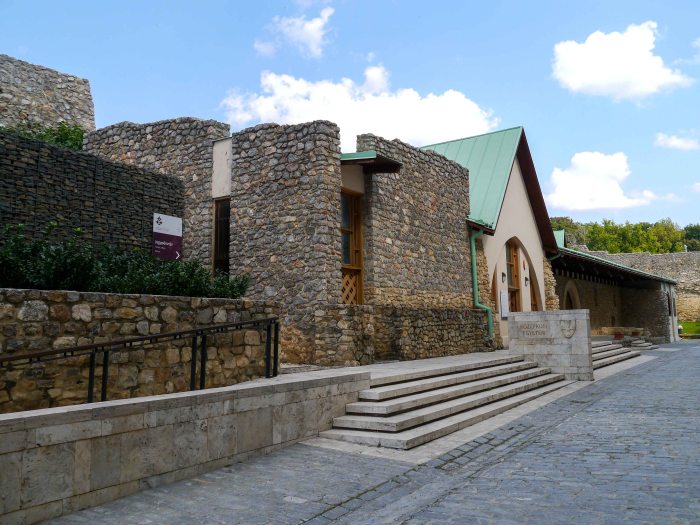
Presently, the building wedged between the St Peter and St Paul [Szent Péter és Pál székesegyház] and the city wall of Pécs is referred to as the Medieval University [Középkori Egyetem] as it is believed to have been one of the structures that housed the first Hungarian university. However, it remains unclear whether it was specifically allocated for educational purposes, as it was not customary during that era to have separate buildings dedicated solely to education.
 Trespasser-on-Earth