
In the shadows of Budapest’s grand historic architecture and monumental statues, a subtler art movement has quietly taken root – a collection of small bronze figures hidden in plane site.
Mihály Kolodko, a Hungarian sculptor from Ukraine, was born in 1978 in Ungvár. In his early years, he was primarily interested in monumental sculpture, as he studied plein-air art at university, during a period when large, awe-inspiring works were favored in the Soviet era. Over time, however, he shifted to creating miniature works and has since gained widespread recognition for his distinctive style of guerrilla art – tiny bronze sculptures that mysteriously appear throughout Budapest, in several other Hungarian cities, and even across Europe.
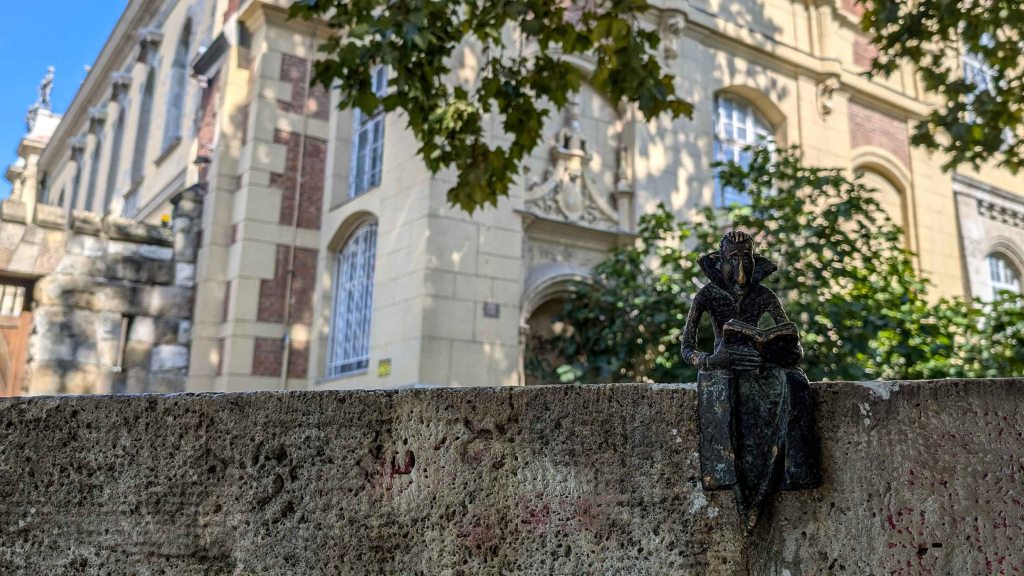
One of his main artistic motivations was freedom. Smaller works are less costly, quicker to produce, and more mobile, enabling the artist to place them in public spaces without – or before – bureaucratic restriction. Yet these small objects can still express monumental ideas. The mini-statues, usually only about 10-15 centimeters in height, often integrate their surrounding as part of the artwork. They are installed in hidden but visible, reachable spots so that discovery itself becomes part of their charm. They are often called “guerrilla sculptures” because they are usually installed without prior permission. Their unexpected presence invites curiosity: passersby must look closely, explore, interpret, and perhaps pause to ask questions about their meaning.
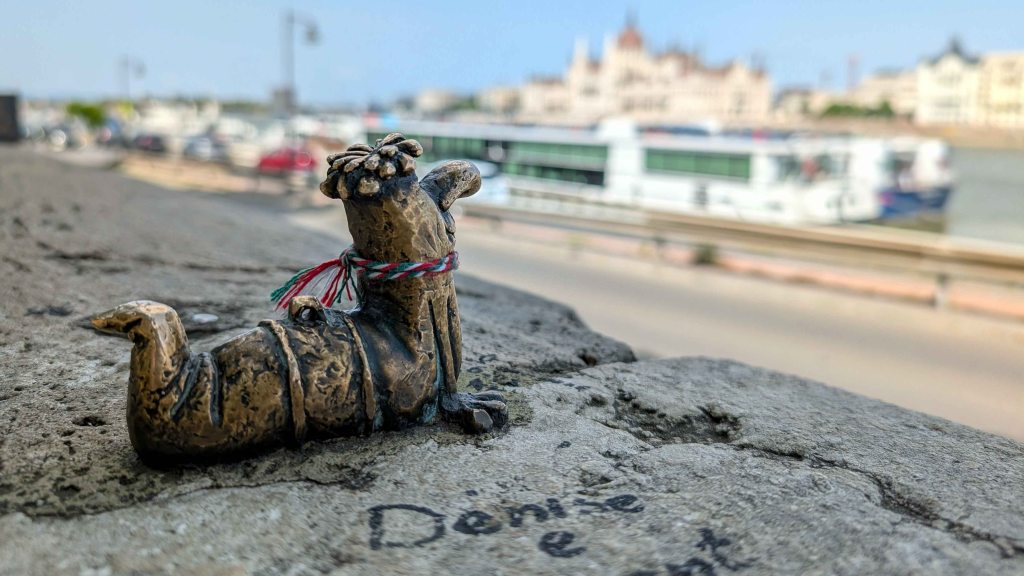
Kolodko’s mini-statues punctuate urban life with whimsy, nostalgia, and both historical and social commentary. Perhaps the most easily noticeable is Checkered-Eared Rabbit [Kockásfülű nyúl], a beloved Hungarian cartoon character. Located near the Buda Castle Palace [Budavári Palota], the rabbit peers through binoculars, leisurely observing Pest and the River Danube below, alongside the tourists who frequent the palace grounds. Many of Kolodko’s works evoke childhood memories. Head Worm [Főkukac], another popular Hungarian cartoon character, is fittingly placed along the Danube promenade. Similarly, the global favorite Winnie the Pooh [Micimackó], hangs from an empty honey jar mounted on the childhood home of writer Frigyes Karinty, who translated Milne’s classic tale into Hungarian. These playful homages bridge Hungarian and international pop culture, inviting moments of recognition and nostalgia in the city’s everyday rhythm.
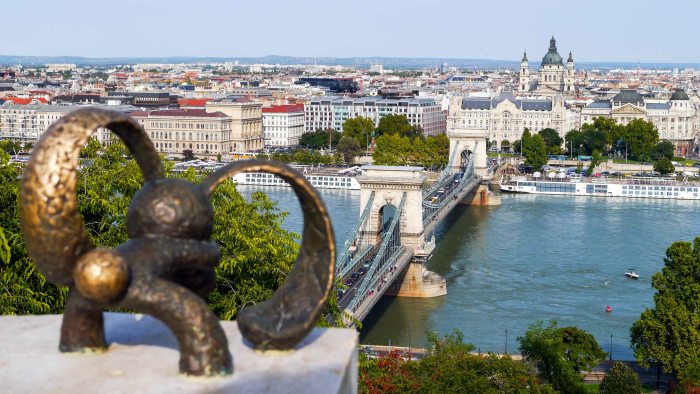
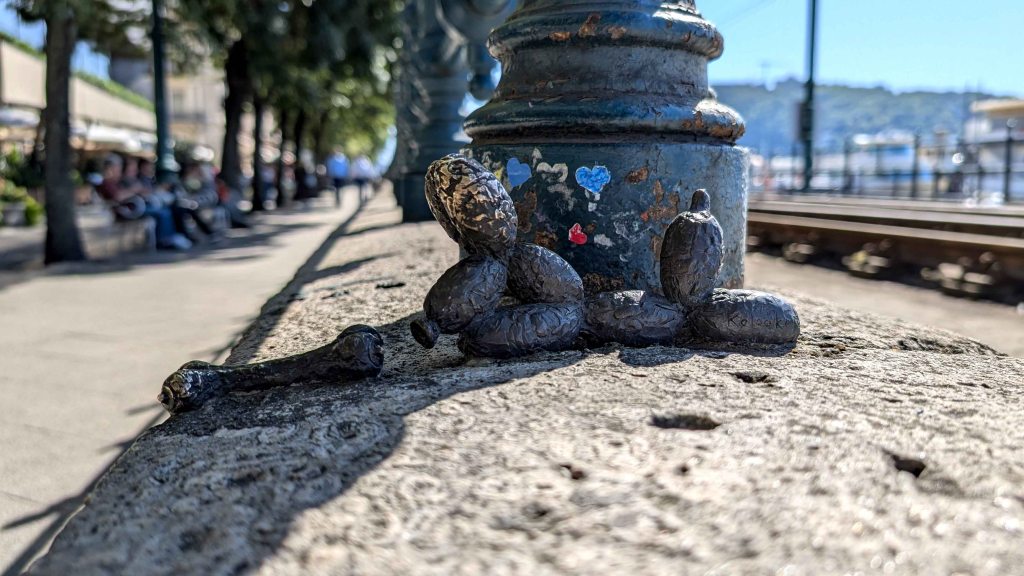
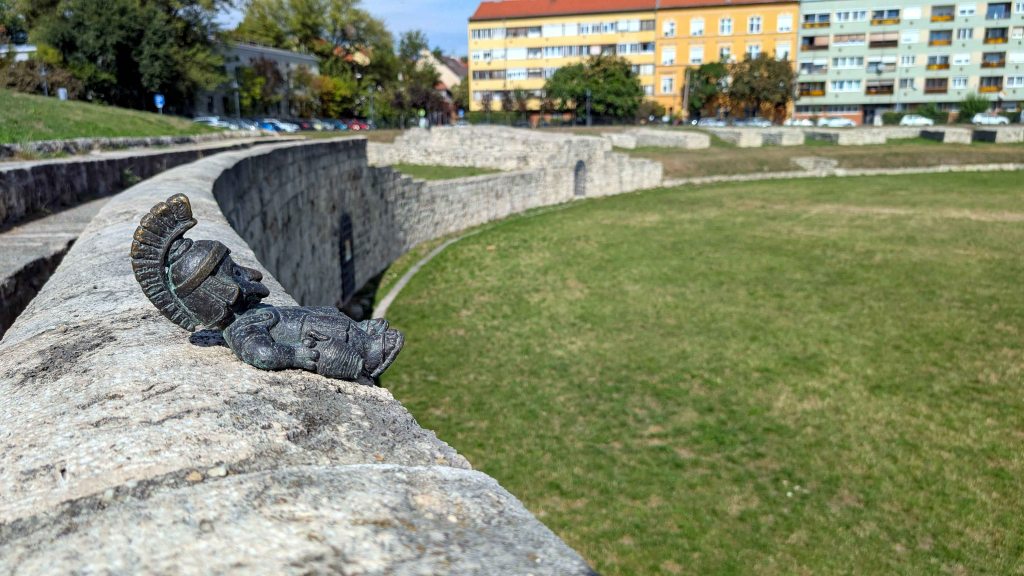
Some sculptures pay tribute to historical figures, such as Emperor Franz Joseph, affectionately known in Hungarian as Ferenc Jóska [Frankie Joe], who is depicted lounging in a hammock on the bridge that once bore his name – a lighthearted take on imperial grandeur that humorously humanizes the once-revered monarch. Others honor local personalities, like Aranka néni and Béla bácsi, the legendary florist couple from the Pasarét neighborhood, whose presence recalls the personal, small-town warmth that still lingers in parts of modern Budapest. Some works serve purely as playful surprises amid everyday architecture – for instance, Balloon Dog with a Bone [Lufikutya csonttal], sprawled lazily along the Danube promenade, offers a cheerful contrast to the city’s stately facades. Still others offer whimsical reflections on history, such as In vino veritas, which depicts an ancient Roman solder lying on his back, drunkenly clutching a bottle of wine. This piece is installed on the remains of an ancient Roman amphitheater, artfully blending history with humor.
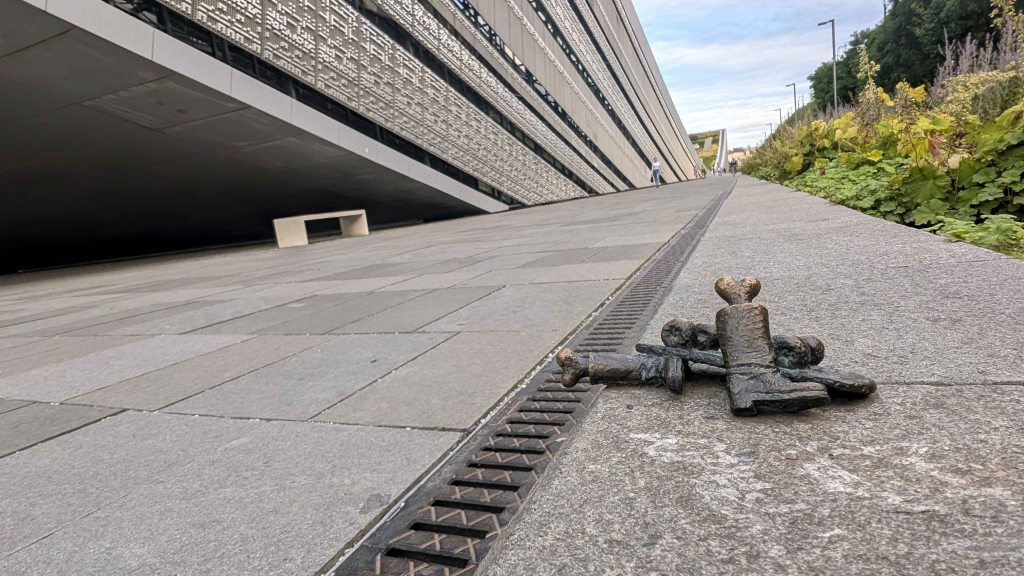
Though often whimsical, Kolodko’s statues can also reflect moments of historical trauma. Among Us commemorates the toppling of the enormous Stalin statue during the Hungarian Revolution of 1956 – a nationwide uprising against Soviet-imposed policies and the government of the Hungarian People’s Republic (1949–1989) that sought political freedom and independence. The sculpture grotesquely represents the pair of boots that remained the statue fell, a haunting reminder of authoritarian collapse. Installed near the site of the original monument, it also features a skateboard – likely a playful nod to the nearby modern building of the Museum of Ethnography [Néprajzi Múzeum], whose sweeping architecture resembles a skateboarding ramp.
These mini-statues invite a kind of urban treasure hunt. Locals, tourists, and art lovers often spot them by chance, photograph them, and share their discoveries on social media. They add a layer of wonder to walking through the city: ordinary streets become open-air galleries, and familiar spaces transform into interactive explorations. Yet, their small scale also makes them vulnerable to weather, vandalism, or theft. Some have been damaged, stolen, or removed, while others mysteriously reappear in new locations. Because many are installed without official permission, they occasionally spark friction with city authorities. While the more whimsical pieces have broad appeal, those with political or cultural references may seem obscure to those unfamiliar with Hungarian history – but that very mystery is part of their enduring charm. To discover a Kolodko statue is to enter into a dialogue between past and present, humor and critique, private memory and public space.

 Trespasser-on-Earth