
Together, Monasterboice and Mellifont Abbey offer an insightful glimpse into the evolution of monastic life in medieval Ireland.
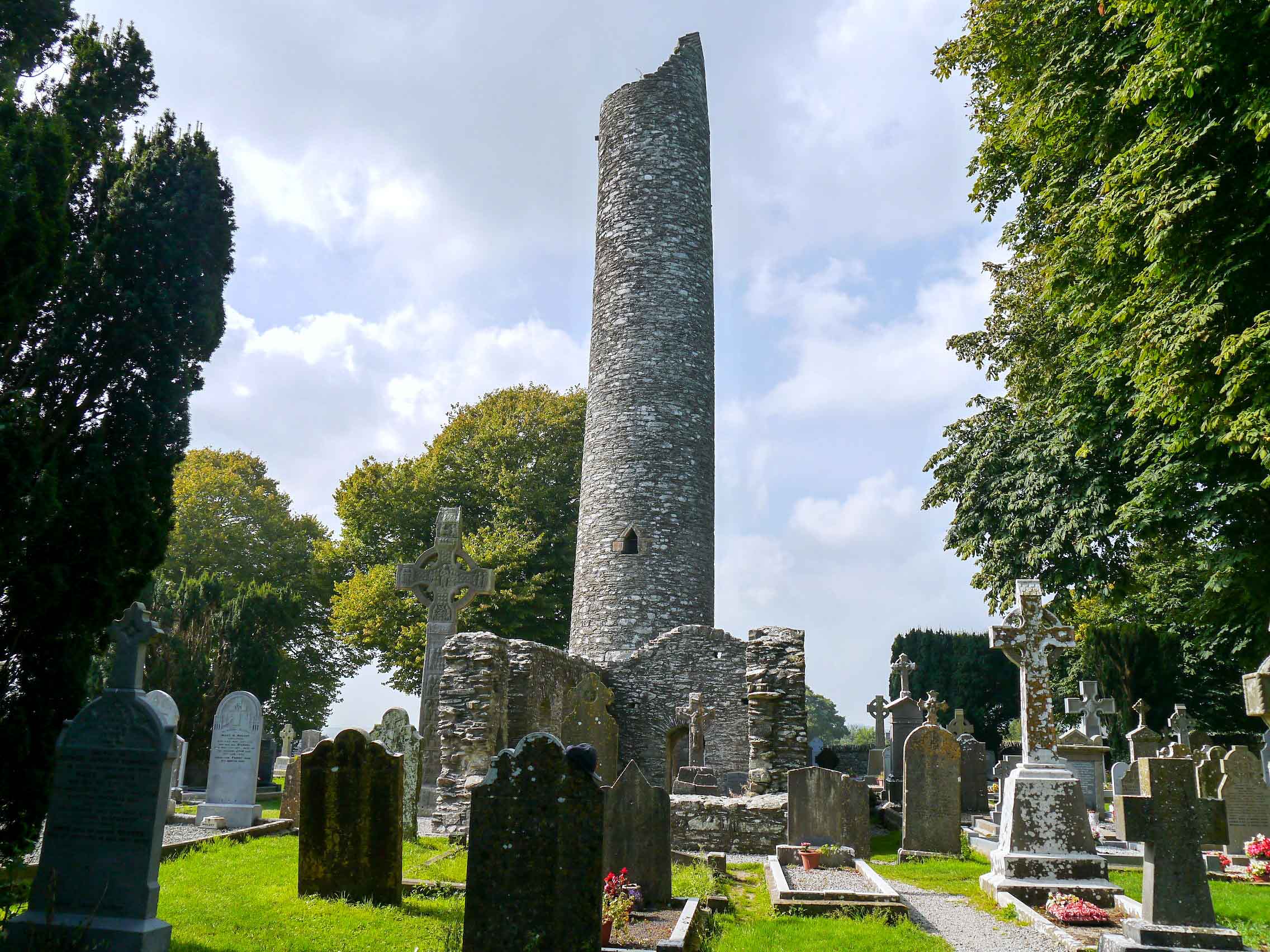
Monasterboice, renowned as one of Ireland’s most important early religious sites, was founded in the 5th century by St Buithe, a lesser-known disciple of St Patrick. Over time, St Buithe’s name evolved into the place name Boyne. The ruins of Monasterboice lie within a historic graveyard. The site features the remains of a round tower, a characteristic element of Irish Christian architecture dating from the 10th to 12th centuries. These tall towers served several purposes: they functioned as bell towers, lookout points against Viking raiders, storehouses for valuables, and places of refuge in times of danger. In 968, Vikings occupied the monastic settlement but were later expelled by a king associated with the nearby Hill of Tara. Historical records indicate that the tower caught fire in 1097, destroying numerous valuable manuscripts and treasures.
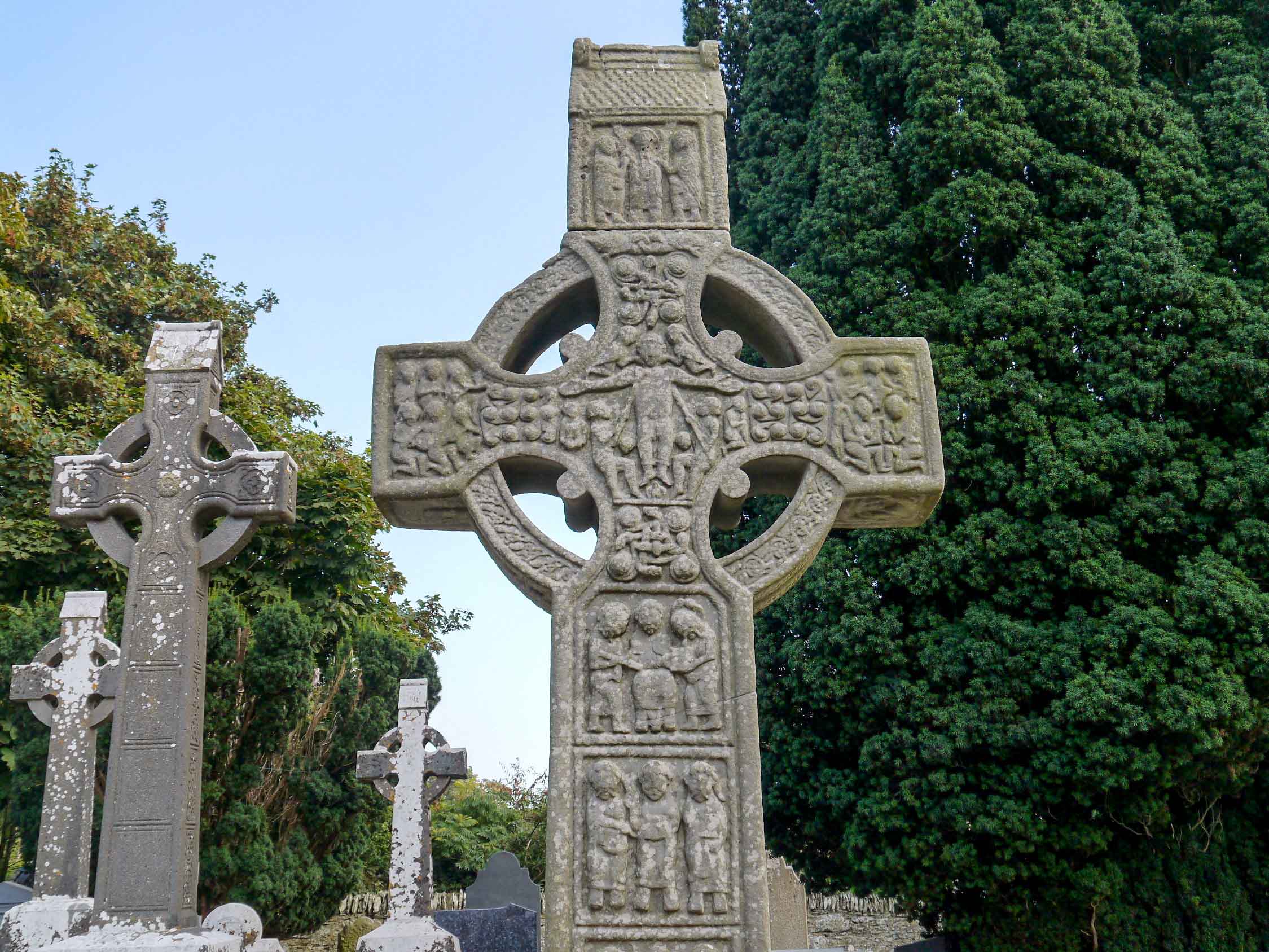
Today, the monastery is particularly renowned for its High Crosses. These monumental stone crosses, mostly carved between the 8th and 12th centuries in Ireland, initially featured geometric ornamentation. Over time, their carvings evolved to include scenes from the Bible. Among them, the 10th-century Muiredach’s High Cross at Monasterboice is widely regarded as the finest of its kind in Ireland. Its western face depicts scenes from the New Testament, beginning at the bottom with the Arrest of Christ, Doubting Thomas, and Christ giving the key to St Peter, and culminating in the Crucifixion. The eastern face shows scenes from the Old Testament, including the Fall of Man, David fighting Goliath, Moses obtaining water from the rock, the Adoration of the Magi, and finally the Last Judgement. Adjacent to the round tower stands the West High Cross, which rises to an impressive height of 6.5 meters, making it one of the tallest high crosses in Ireland. Unfortunately, it has weathered considerably more than Muiredach’s High Cross. Noteworthy carvings include the Death of Christ as well as scenes of David slaying a lion and a bear. The North High Cross, the least remarkable of the three, is believed to have been vandalized by the troops of Oliver Cromwell in the 17th century. It displays a Crucifixion scene along with spiral ornamentation. Through their carved imagery, these crosses served an important educational function, conveying biblical stories to a largely illiterate population.
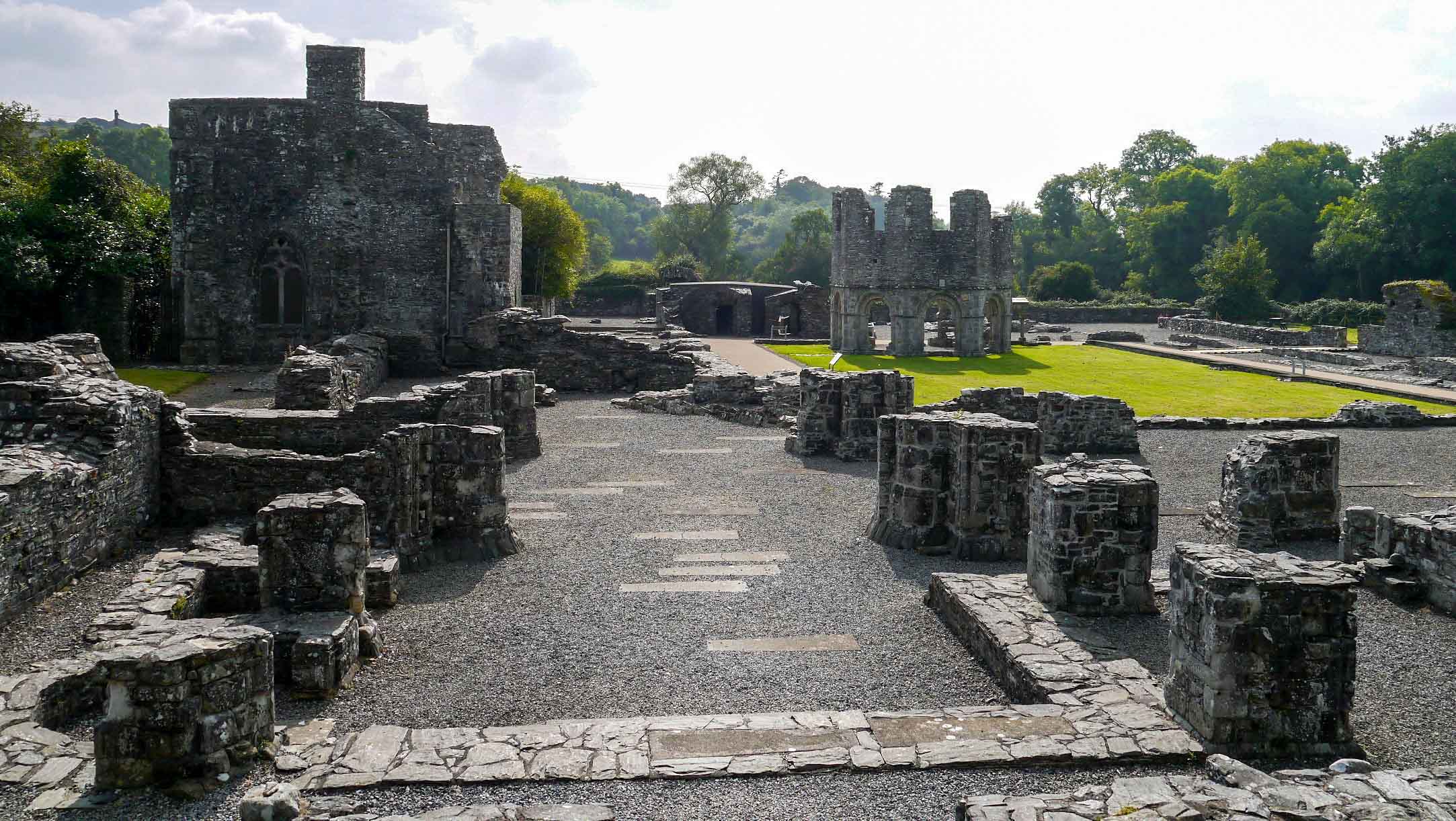
Mellifont Abbey, established in 1142, holds the distinction of being the first Cistercian monastery in Ireland. Representing the formal architectural style of continental monasticism, the abbey remains the finest example of Cistercian architecture in the country. It was founded by St Malachy (1094-1148), Archbishop of Armagh, who sought to reform Irish monastic life, which he believed had become extravagant and scandalous. To establish an exemplary monastery at Mellifont, he invited a group of Cistercian monks from Clairvaux Abbey in France. Unsurprisingly, tensions soon arose between the local clergy and the foreign monks, eventually leading to the return of many of the French monks to France. Nevertheless, the development of Mellifont Abbey continued, and the monastery soon became the mother house of the Cistercian order in Ireland. Over time, 21 additional Cistercian monasteries were established across the country under Mellifont’s authority. At its height, the abbey is believed to have housed around 400 monks. In 1539, following the Dissolution of the Monasteries ordered by Henry VIII, Mellifont Abbey was closed and later converted into a fortified Tudor manor house.
Today, the abbey lies in ruins, yet its surviving remains still convey the former grandeur and scale of the complex. One of Mellifont’s most distinctive structures is the 13th-century lavabo, an octagonal washing area where monks cleansed their hands in a fountain before meals. Additionally, the 14th-century chapter house features an impressive vaulted ceiling and a floor paved with glazed medieval tiles taken from the abbey church.
Sources
https://www.discoverboynevalley.ie
https://mellifontabbey.ie
 Trespasser-on-Earth