Built by a nomadic group of merchants known as the Nabataeans, Petra remains a timeless testament to human ingenuity, architectural mastery, and urban resilience.
Petra’s distinctive rock-cut architecture and remarkably advanced water management system have captivated explorers, scholars, and travelers for centuries, earning it a place among the world’s most extraordinary archaeological sites. Yet Petra is more than just an architectural marvel – it is a narrative etched in stone, telling the story of how a once-nomadic Arab people, the Nabataeans, transformed a rugged, arid landscape into a flourishing metropolis: the capital of the Nabataean Kingdom.
Although the region had been inhabited since prehistoric times, Petra was little more than a remote desert watering hole before the arrival of the Nabataeans. This ancient Arab people, originally from northeastern Arabia, migrated westward around the 6th century BC and eventually settled in Petra’s natural basin. Between the 4th and 2nd centuries BC, they emerged as a distinct civilization and a formidable political force. By the 1st century BC, Petra had blossomed into the beating heart of the Nabataean Empire – a thriving urban center that may have housed between 20,000 and 30,000 inhabitants. As skilled merchants and cultural intermediaries, the Nabataeans capitalized on Petra’s strategic position at the crossroads of major caravan routes that transported frankincense, myrrh, turquoise, peridot, and other gemstones from Arabia, as well as spices, silk, and luxury goods from East Asia to the Mediterranean world. They ensured the safety of caravans within their territory and organized essential provisions, including food, water, shelter, and fresh camels. Caravan stations were established at fixed intervals – typically around 50 kilometers apart – corresponding to the average daily distance a camel caravan could travel. In return, traders paid taxes for these services.
Yet Petra’s geography offered more than just economic advantage. Spread across a vast plane measuring approximately 23 by 11 kilometers, the city was naturally fortified by steep cliffs. On these rocky outcrops, the Nabataeans built watchtowers to monitor the surrounding region and defend it from raiders or potential invasions by neighboring kingdoms. Access to the city was limited to a single, narrow entrance: the Siq – a 1.2-kilometer-long gorge carved over millennia by erosion. In a desert where water was scarce, Petra held another crucial advantage: it lay at the confluence of several seasonal riverbeds, known as wadis. These natural channels, which funneled flash floodwaters, provided essential water sources for a city of Petra’s scale. Still, choosing such an arid site for their capital posed serious challenges. Yet the Nabataeans not only survived – they thrived, thanks to their extraordinary ingenuity and a sophisticated hydrological system.

The Nabataeans’ prosperity fueled a wave of ambitious architectural projects, and their artisans developed a distinctive style that blended Hellenistic, Egyptian, and Mesopotamian influences into a uniquely Nabataean aesthetic. Petra is not simply built – it is sculpted. Unlike other ancient cities that were constructed from quarried stone, most of Petra’s surviving monuments emerge as literal extensions of the surrounding landscape. The city features more than 2,700 known structures carved directly into the rose-red rock, which had been shaped by millions of years of natural erosion before being transformed by human hands. These rock-cut marvels – tombs, temples, dwellings, altars, and civic buildings – are not merely remnants of a lost civilization, but enduring testaments to Nabataean ingenuity, geological mastery, exquisite craftsmanship, and aesthetic vision. Created with crude tools and limited resources in a barren desert, these structures represent extraordinary human achievement. They are not only the wonders of Petra, but masterpieces of the ancient world.
Widely regarded as Petra’s most iconic monument, the Treasury [Al-Khazneh], embodies the grandeur, artistry, and engineering brilliance of the Nabataean civilization. Its lavish façade, rising over 40 meters high, is carved directly into a sheer cliff face. The two-tiered design features soaring Corinthian columns with intricate capitals, sculpted mythological figures, and an ornate tholos. Crowning the structure is a massive funerary urn, standing over 3.5 meters tall, which – according to legend – once held a great treasure, giving the monument its modern name. Although two millennia of wind and sand have eroded many of the façade’s finer details, its artistic beauty remains strikingly visible. Yet for all its exterior splendor, the interior of the Treasury is remarkably austere. Behind the elaborate façade lies a large central chamber flanked by three plain, roughly hewn rooms. The walls are unadorned, lacking reliefs or inscriptions that might offer clues to the monument’s original function. While many scholars believe it likely served as a royal tomb – possibly for Aretas IV, the greatest of the Nabataean kings – no definitive evidence confirms this. The absence of inscriptions identifying its occupant leaves its purpose open to speculation. What is certain, however, is that the scale and ornamentation of the Treasury far surpass those of most other tombs in Petra, suggesting it held exceptional significance – weather royal, religious, or ceremonial.
What makes the Treasury even more extraordinary is not just its beauty, but the immense technical challenge it posed to its builders. Carving such a monumental façade into a vertical cliff face required a completely reimagined approach to construction. Traditional bottom-up methods were unfeasible: the sloped and uneven rock would have made precise alignment from the ground nearly impossible. Moreover, working from below would have exposed laborers to falling debris and significantly limited their mobility within the confined space. To complicate matters further, Petra’s arid environment offered little access to wood, making the construction of conventional scaffolding difficult. Confronted with these limitations, the Nabataeans devised an ingenious top-down carving technique. This innovative approach not only ensured greater precision and safety but also stands as a testament to their remarkable engineering expertise and adaptability.
Before any carving could begin, the Nabataeans established a sophisticated access system to reach the upper sections of the cliff. On a neighboring hill, they carved a broad staircase and a large cave that served both as a shelter for workers and a depot for tools. From there, a rudimentary bridge spanned across to the rear of the cliff face where the future Treasury would take shape. Carved walkways allowed laborers to access the façade directly. Once positioned above the intended site, the builders began the meticulous process of sculpting the monument from the top down. This likely began with a horizontal tunnel bored into the cliff face, providing access to the exterior surface of the future structure. From this perch, workers could begin carving the uppermost elements – such as the ornate funerary urn – with extraordinary precision. As each upper section was completed, the builders moved downward by carving two vertical rows of notches on either side of the emerging façade, likely used as footholds or makeshift ladders. A new horizontal tunnel would then be dug below the previous one, and the process repeated layer by layer until they reached the base. Each phase demanded exceptional precision – once a section was finished, it could not be revised or corrected later. Evidence of this monumental operation remains visible today. The cave to the right of the façade, the carved walkway at the top, and the rows of notches flanking the cliff all stand as silent witnesses to the ingenuity of the Nabataean builders. In the absence of written records, these archaeological traces offer rare insight into the extraordinary engineering behind one of Petra’s most iconic monument.
Equally impressive, the Monastery [Ad-Deir] is another colossal rock-carved structure that highlights the Nabataeans’ exceptional adaptability in construction techniques and mastery of craftsmanship. Perched atop a mountain and accessible only by climbing more than 800 steps, the Monastery is grander in scale but less ornamented than its more famous counterpart, the Treasury. Despite its minimal decoration, it displays the same level of technical brilliance. At first glance, it appears to have been built using methods similar to those employed at the Treasury. However, the gentler slope of the rock wall at the Monastery required the builders to adapt their approach to the terrain. Reaching the top of the cliff face was relatively straightforward, as workers could ascend the slope directly. As a result, carving the massive 10-meter-high funerary urn crowning the monument was considerably less complex. The rest of the construction unfolded in two main stages. First, workers carved a giant staircase into the mountainside in front of the future façade. Then, layer by layer, they gradually removed the excess stone from top to bottom to reveal the structure’s final form. Although its decoration is restrained, the Monastery stands as a testament to exceptional craftsmanship. Unlike ornate embellishments or decorative capitals that can conceal imperfections, its clean, bold lines demanded absolute precision and left no room for error. A single miscalculation, a natural flaw in the rock, or the breakage of a cornice or capital during carving could have irreparably compromised the structure and jeopardize the entire project.
An even more striking example of the Nabataean builders’ ability to understand and work with geological weaknesses is the Faultline Tomb, located on a mountain northwest of Petra’s city center. At the core of this structure lie two deep horizontal cracks – natural fault lines in the rock. To construct a tomb in such a location, the builders had to ingeniously incorporate these fractures into the architectural design, carefully adjusting proportions and placements to maintain structural integrity. The entryway was carved up to the level of the lower fault line, while the columns were sculpted to reach the higher one. This precise alignment reveals the builder’s deep understanding of their materials and their exceptional skill in adapting designs to accommodate natural imperfections. Rather than seeing these flaws as obstacles, the Nabataeans embraced them, creating a monument that is both structurally sound and stylistically in harmony with the broader Nabataean architectural tradition.


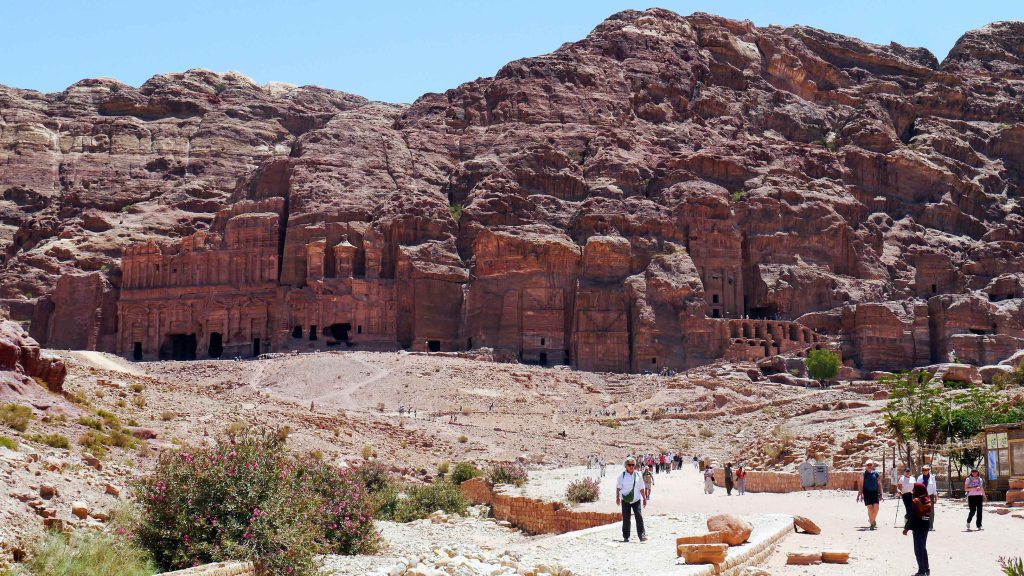
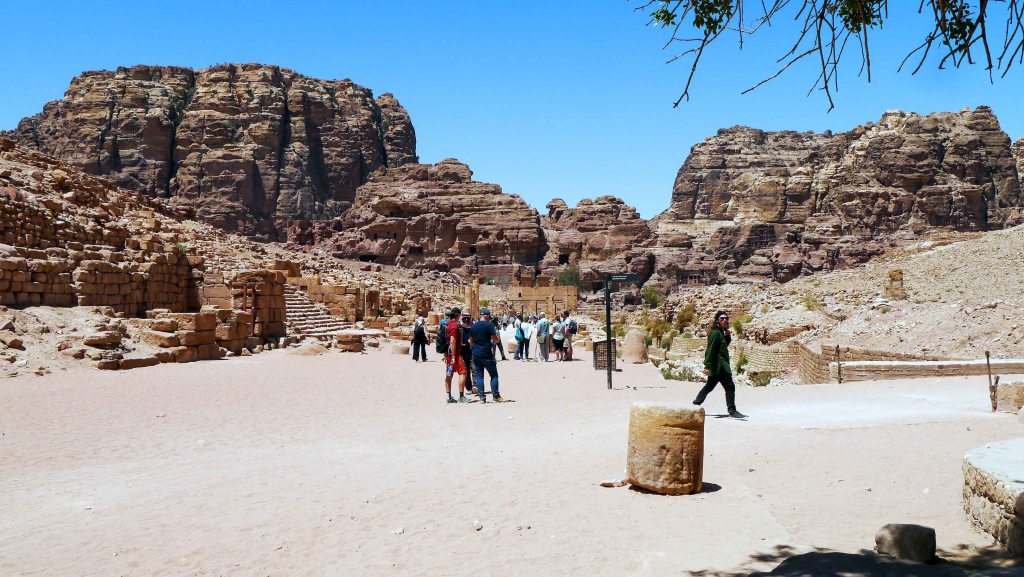
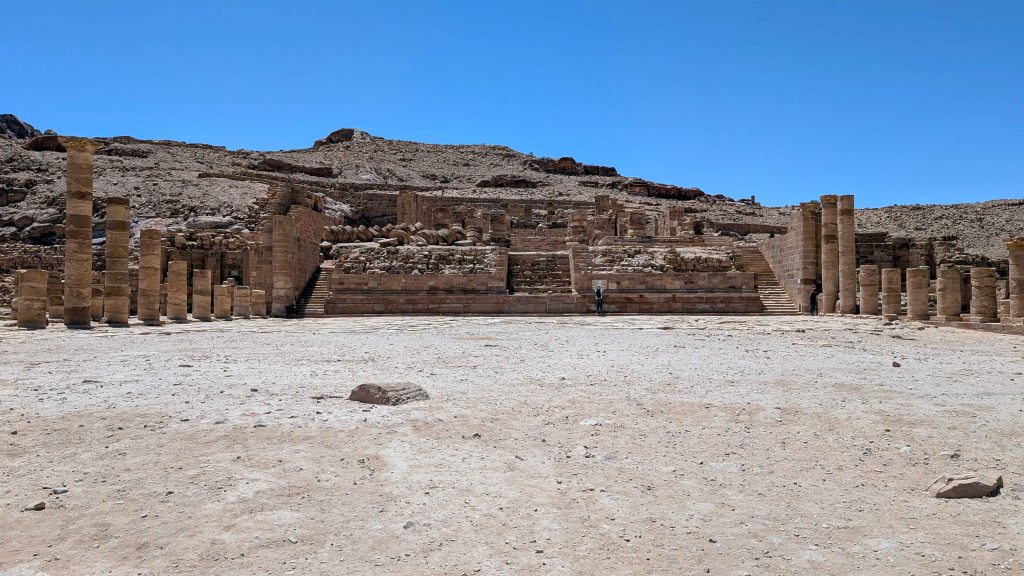
While Petra is best known for its iconic rock-carved monuments, the ancient Nabataean city was far more than a sculptural wonder etched into cliffs. At the height of its prosperity, Petra also featured a wide range of freestanding stone structures – temples, administrative buildings, and residences – all constructed using traditional techniques and locally quarried sandstone. Although many of these buildings have crumbled or disappeared beneath layers of sediment and time, they once formed the vibrant core of a thriving desert metropolis. The exact number of such structures remains unknown. One of the most impressive surviving examples is the so-called Great Temple, a monumental complex spanning over 7,500 square meters, which dominates the archaeological heart of Petra. It stands as a testament to Nabataeans’ resourcefulness and engineering prowess.
Much of the stone used in Petra’s construction was sourced locally. The same workers who carved monumental façades into the cliffs also extracted large quantities of sandstone from the surrounding mountainsides, repurposing the surplus stone for use in the freestanding architecture. However, the vast amount of material required for Petra’s urban development led to extensive quarrying operations across the surrounding landscape. One of the largest known quarries is located atop Al-Madhbah Hill, reachable by a short hike from Petra’s core. The scale of excavation is astonishing: two imposing, seven-meter-high stone obelisks dominate the site. These monolithic columns stand as the last remaining indicators of the mountain’s original height before it was systematically carved away, offering a rare and valuable glimpse into Nabataean quarrying techniques. Workers likely used basic tools – mallets, iron wedges, and picks – to extract blocks weighing hundreds of kilograms. Transporting these massive sandstone blocks posed another significant challenge, one still partially shrouded in mystery due to the absence of written records. As most quarries are located at higher elevations than the valley floor, it is assumed that the stones were moved downhill using gravity-assisted wooden rollers. Raising the heaviest blocks – some weighing several tons – up to heights of 35 meters introduced an additional level of complexity. Although the Nabataeans left no documentation of their construction techniques, scholars have drawn comparisons to methods used by other ancient civilizations. One plausible solution is the derrick – a simple wooden lifting device consisting of a beam, pulleys, and ropes – capable of hoisting large stones and swinging them into place with a pendulum-like motion.
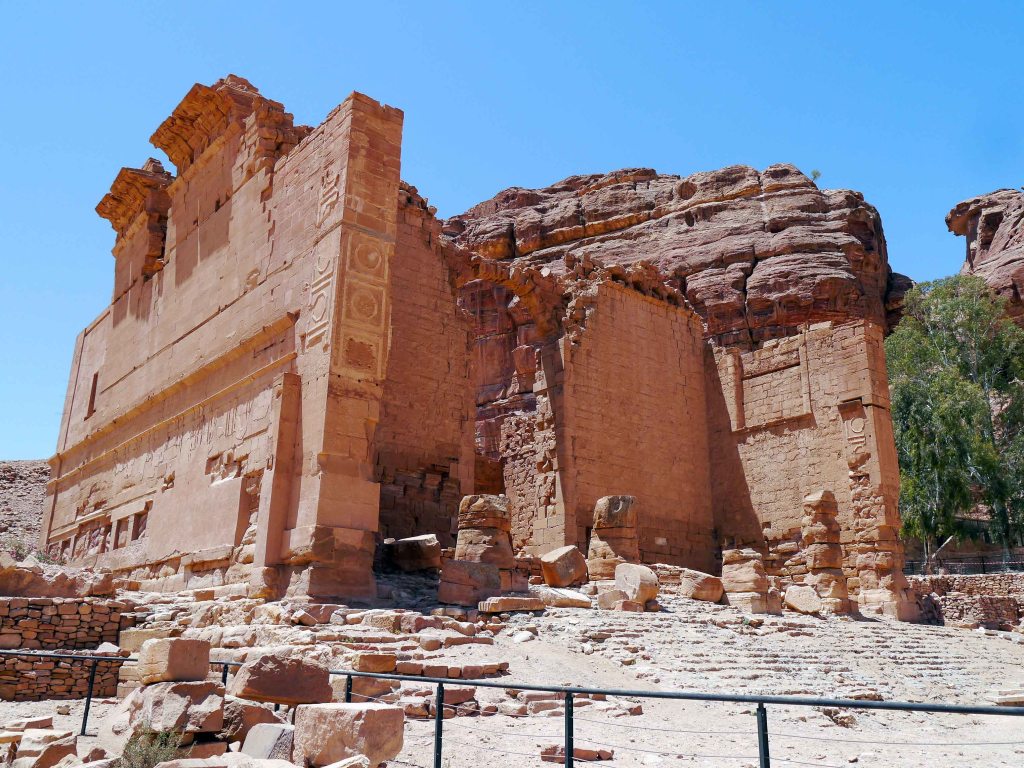
While Petra’s strategic location offered numerous advantages, its position along a major fault line posed a significant risk. The city lies at the junction of the Arabian Plate and the Sinai Subplate – a tectonic boundary stretching over 1,200 kilometers – making the region highly prone to seismic activity. Throughout its history, Petra has endured several powerful earthquakes, many of which contributed to the collapse of its freestanding structures. Yet remarkably, one monumental edifice has withstood both time and tremor: Qasr al-Bint. This enduring structure stands as a testament to the Nabataeans’ advanced understanding of structural dynamics and may represent one of the earliest known examples of earthquake-resistant architecture. The temple’s square layout served as its first line of defense. In square structures, seismic forces are distributed more evenly across all four walls, minimizing the risk that one side will bear disproportionate stress and collapse. Beyond this geometric advantage, the Nabataean builders employed a more sophisticated and uncommon technique: the integration of seismic-dampening wooden beams within the stone masonry. These cedar beams, embedded at regular vertical intervals, acted as flexible transoms within the rigid structure. Unlike stone, wood has the ability to absorb and redistribute energy. As seismic waves traveled upward during an earthquake, they encountered the embedded beams, which helped dissipate the force laterally. This reduced vertical stress on the upper portions of the structure and mitigated damage. Because no other freestanding structure in Petra employed this method – and none have survived the city’s long history of earthquakes – it is reasonable to conclude that this system of flexible reinforcement played a critical role in Qasr al-Bint’s longevity.
In this harsh and arid desert, survival has always depended on the ability to manage nature’s extremes. Chief among these was water scarcity – a challenge that loomed large in Petra. Rainfall in the region is infrequent and unpredictable, typically arriving in sudden, torrential downpours between December and March. This presented a dual dilemma for the Nabataeans: how to collect and store every precious drop of water for year-round use, while simultaneously protecting the city from the destructive force of flash floods. The Nabataeans met this challenge with remarkable ingenuity and technical sophistication. They engineered an advanced and integrated hydrological system designed to capture, purify, store and distribute water with exceptional efficiency. There achievement remains unparalleled in the context of ancient urban planning.
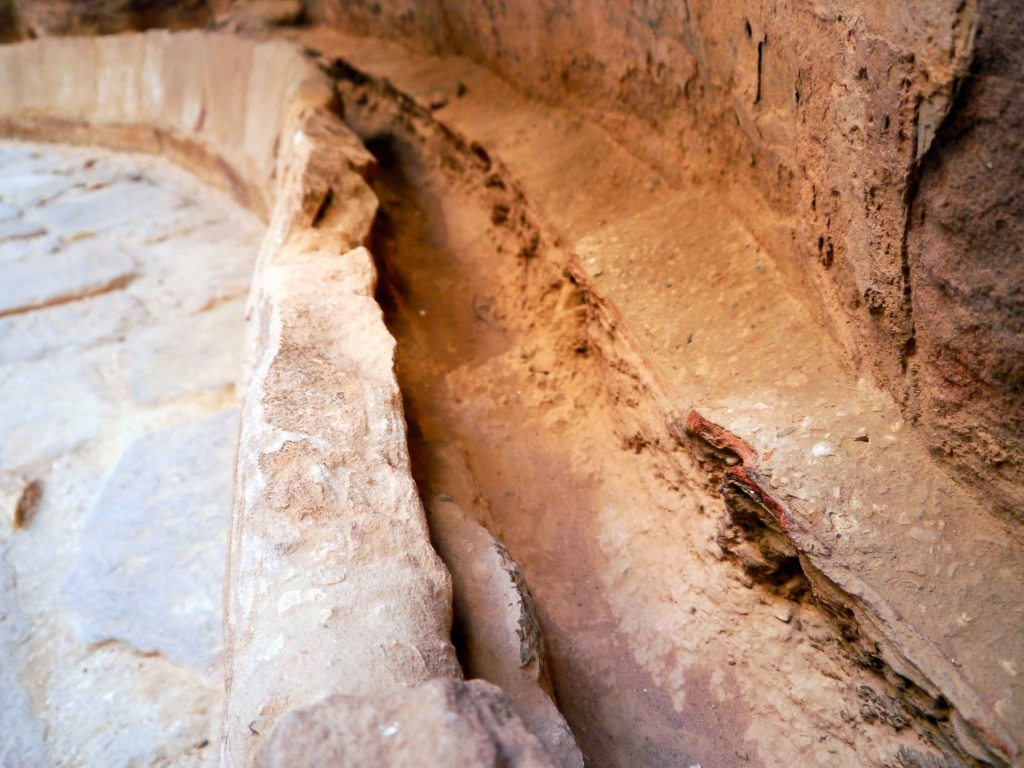
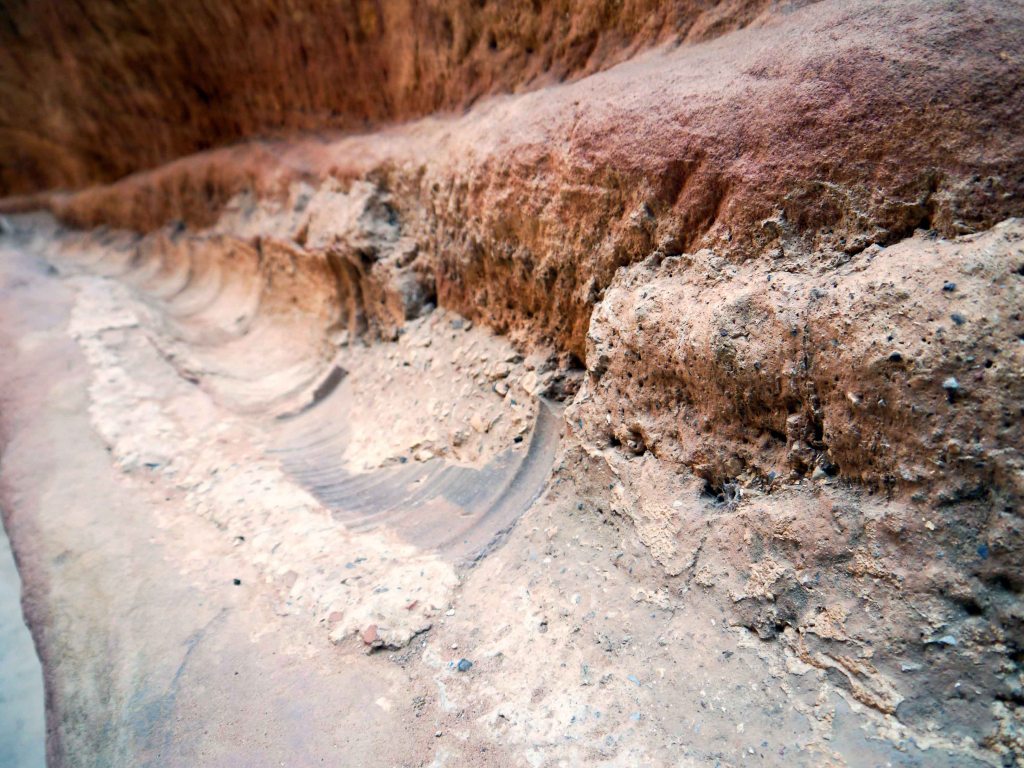
The water management system they developed was extraordinarily complex and expansive, incorporating diversion channels, dams, reservoirs, and filtration basins. Rainwater from the surrounding cliffs was first directed into a series of sedimentation basins, where silt and debris gradually settled in multiple stages. This multi-phase filtration process demonstrates the Nabataeans’ keen understanding of water quality as well as quantity. Once filtered, the water was channeled into the city through a sophisticated network of aqueducts, open-air channels, and clay pipes embedded into the rock. The open channels were coated with white waterproof mortar to prevent seepage into the porous sandstone. The clay pipes – assembled from carefully crafted segments – were sealed with a waterproof coating, and their diameter was precisely calibrated to maintain steady pressure. This design allowed water to flow unobstructed toward the city center and even ascend gentle slopes – an impressive achievement considering the limitations of ancient technology. The cliffs flanking the Siq, the narrow gorge leading into Petra, still conceal remnants of these channels and pipes, once used to distribute water throughout the city. Basins and dams visible along the route offer further evidence of this hydraulic ingenuity.
No longer reliant on sporadic rainfall, the Nabataeans transformed one of the most arid landscapes on Earth into a thriving urban oasis, unlocking the full potential of their desert environment. The city flourished with verdant gardens, shaded courtyards, and elaborate bathing facilities. At the heart of Petra, adjacent to the Great Temple, archaeologists uncovered one of its most impressive and unexpected structures: a vast Bathing Complex. Requiring thousands of liters of water to function, the complex featured its own garden and a grand basin, supported by a sophisticated network of pipes, hydraulic surfaces, and cisterns. Even more astonishing is the Thermal Spa Complex, perched high above the city atop Khubthah Hill – an entirely unexpected location for such an elaborate facility. Accessible through a large courtyard, the complex opened onto a banquet room on one side and a spa on the other, which followed the classic layout of Greco-Roman bathhouses. Visitors would begin their experience in the frigidarium, a room with a cold plunge pool, then move to the tepidarium, a warm transition room, followed by several heated chambers containing small basins for communal bathing. The spa employed a hypocaust heating system, which funneled hot air and smoke from a hearth through an underfloor chamber supported by stacked bricks. The heated air circulated beneath the floors and rose through the walls, which were embedded with a network of clay pipes. Roof vents allowed steam and smoke to escape, ensuring ventilation. These spaces reveal not only advanced technical expertise but also the Nabataeans’ remarkable ability to adapt foreign architectural traditions to suit their local environment and cultural context.

Petra remains a masterpiece of ancient engineering, architecture, and urban planning. Although the Nabataeans left no written records to document their achievements, their monuments speak volumes. Petra stands as a powerful testament to what human determination and ingenuity can accomplish – even with limited resources in one of the world’s most inhospitable environments. In just 200 years – a timeframe that underscores not only the monumental scale of the undertaking but also the remarkable continuity of vision that guided the city’s development over generations – the Nabataeans transformed a barren desert into a dazzling metropolis: a capital of wealth and artistry, innovation and spirituality. They succeeded through adaptability, foresight, and scientific understanding – mastering stone, controlling water, and withstanding the forces of nature. Though time has weathered its facades, Petra endures not merely as a relic of the past, but as a timeless symbol of humanity’s boundless creative potential.
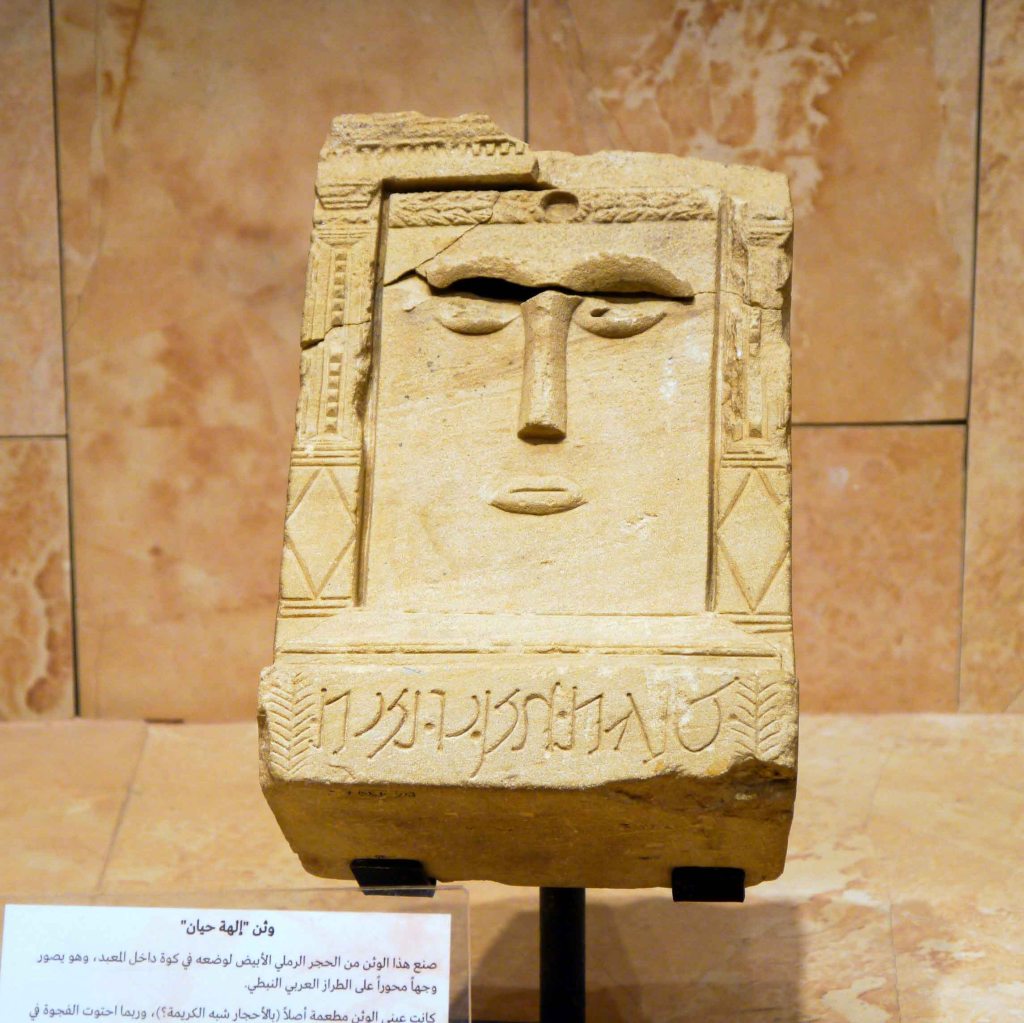
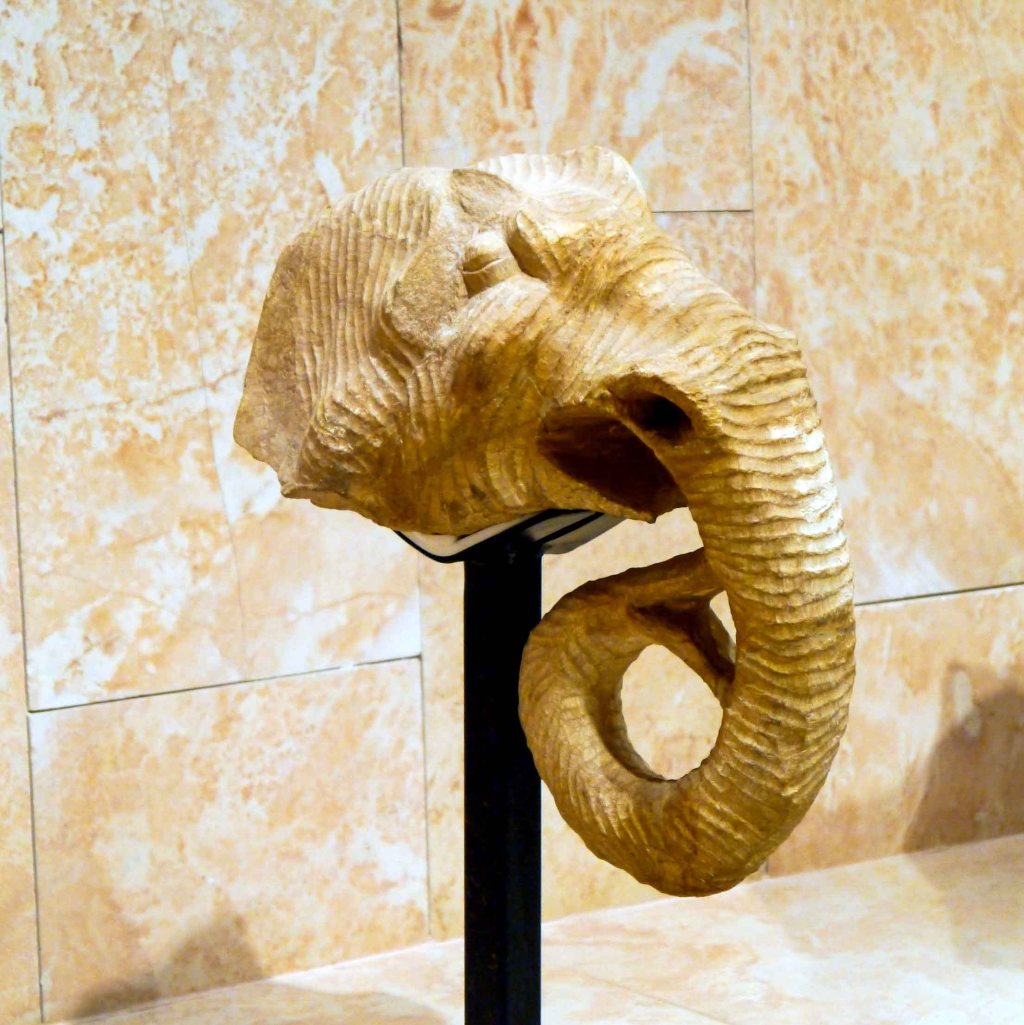
Today, Petra is one of the most visited archaeological sites in the world – an essential stop on any ultimate Jordanian road trip. Designated a UNESCO World Heritage Site in 1985, it is also a protected archaeological park and one of the New Seven Wonders of the World, attracting visitors from across the globe to its windswept valleys, crimson cliffs, and timeless monuments. Despite its global fame, undeniable grandeur, and decades of archaeological exploration, Petra remains a city of secrets. Its vast expanses and silent cliffs still guard untold stories, with much of its ancient fabric buried beneath layers of sand, rubble, and time – awaiting discovery. In 2024, a remarkable find beneath the Treasury reignited global interest in Petra’s enduring mystery. Archaeologists unearthed 12 remarkably well-preserved skeletons just behind the monument’s ornate façade, within what appears to be a previously unknown burial chamber. This unexpected discovery not only deepens our understanding of Nabataean funerary practices but also challenges long-held assumptions about the function and symbolism of the Treasury itself. As archaeological work continues, newly uncovered structures, artifacts, and insights are shedding light on the Nabataeans’ complex society, far-reaching trade networks, and spiritual life – offering revelations that may yet reshape our understanding of this ancient civilization.
While Petra’s most iconic landmarks – such as the Siq, the Treasury, and the Great Temple – can be visited on a half-day tour, those who choose to linger are rewarded with a much deeper and more intimate experience. A full day allows for a comprehensive journey along Petra’s main trail, stretching from the Visitor Center to the sacred precinct of Qasr al-Bint, with ample time to explore the Royal Tombs and climb to either the Monastery or the High Place of Sacrifice. With two or more days, the experience becomes truly immersive. Visitors can tackle both major hikes at a more relaxed pace, uncover lesser-known trails, and venture off the beaten path to discover hidden tombs, unexcavated ruins, and panoramic views rarely seen by day-trippers. An extended stay also provides the opportunity to visit nearby Siq al-Barid, commonly known as Little Petra – a smaller, more intimate Nabataean site that likely served as a caravanserai, offering lodging and provisions to traders traveling along the incense and spice routes. Not to be missed is Petra by Night, a rare and evocative way to experience the ancient Nabataean capital as it may have appeared to travelers centuries ago – bathed in candlelight beneath the quiet stillness of the desert night.
Sources
https://international.visitjordan.com/
https://international.visitjordan.com/Wheretogo/Petra
https://visitpetra.jo/en
The Legendary City of Petra, Secrets of the Ancient Builders (documentary)
 Trespasser-on-Earth