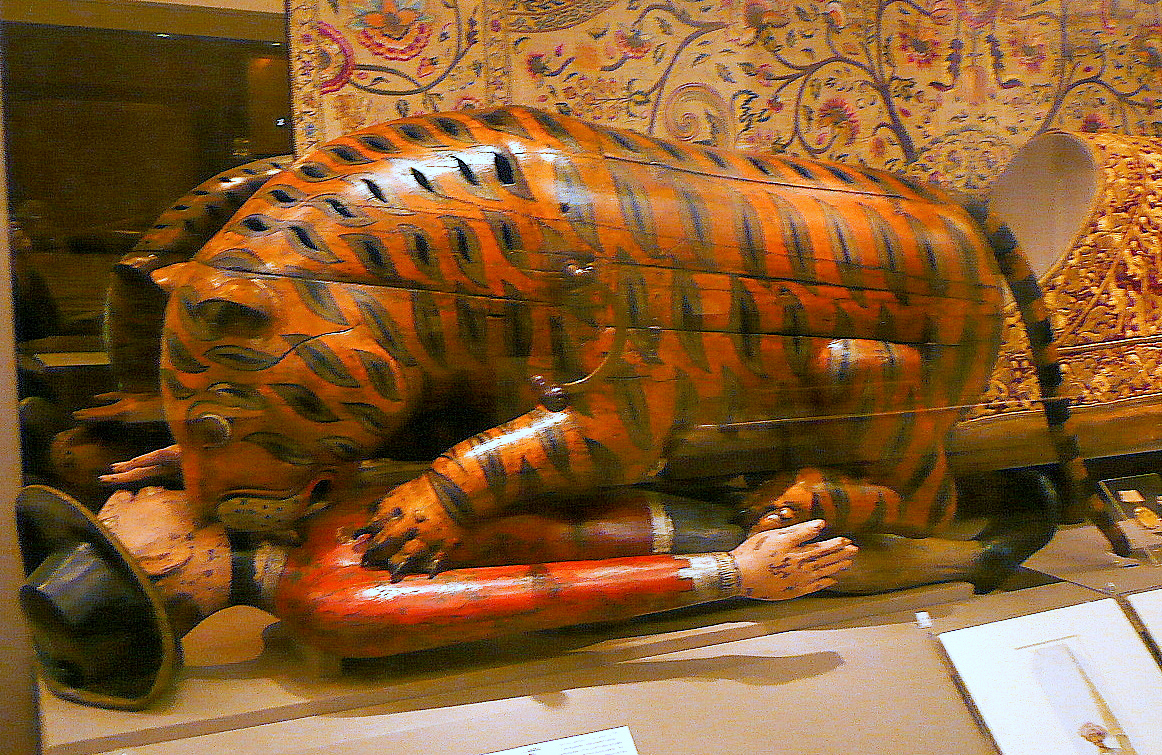
This nearly life-size ‘musical instrument’ depicts a tiger devouring a British soldier.
Tippoo’s Tiger is among the most enduringly famous artifacts displayed at the Victoria and Albert Museum in London. It was made in 1793 for Tippoo Sultan, who ruled Mysore in South India between 1782 and 1799. He kept this wooden semi-automaton in the music room of his palace. By turning the handle located on the side of the instrument’s body, a concealed mechanical organ produces the unsettling sounds of a growling animal and the agonizing cry of its prey.
The tiger, revered as a symbol of its owner’s power, held special significance as Tippoo’s personal emblem. He had many of his possessions decorated with tigers and tiger stripes. His throne, embellished with jeweled golden tiger head finials, rested upon a life-size tiger. Tiger heads were also incorporated into his swords and guns. In addition, he commissioned small bronze mortars shaped like crouching tigers for his army, while his soldiers wore tunics with tiger stripes woven into the fabric. Even his coinage featured intricate tiger stripes as part of the decorative motif.
Tippoo, a formidable leader, fought off numerous attacks on his kingdom by the army of British East India Company. The company had been founded in 1600 for trade within the Indian Ocean region. By the mid-1700s, they owned half of the world’s essential commodity trade, including cotton, silk, indigo, spices, tea, and opium. As the 18th century neared its end, the company expanded its authority, governing vast regions of the Indian subcontinent and exercising both administrative and military control. Their dominion lasted until 1858 when the British Crown assumed direct governance of India through the establishment of the British Raj.
Tippoo was defeated and killed by the British in 1799, and following his demise, the instrument was seized from his palace and transported to London. Initially, it was exhibited in the reading room of the East India Company Museum in 1808, swiftly capturing the fascination of visitors. During that time, the handle that controlled the growling and wailing could be freely turned by the public. Over time, the handle disappeared, much to the relief of the students using the reading room. The instrument was later relocated to the South Kensington Museum (now known as the Victoria and Albert Museum) in 1879, where it continues to intrigue visitors.
 Trespasser-on-Earth