Nestled amidst the vast expanse of the Pacific, the island of Oahu stands as a testament to nature’s magnificence and human ingenuity, offering a diverse array of experiences to satisfy the wanderlust of every traveler.
This circle island tour of Oahu, starting in Waikiki, encapsulates the island’s finest attractions: stunning ocean vistas, lush mountain landscapes, immersive cultural experiences, and enlightening historical insights.
| Start | End | Distance (km) | Duration (min) |
|---|---|---|---|
| Honolulu (Waikiki Aquarium) | Diamond Head Lookout | 2.4 | 4 |
| Diamond Head Lookout | Halona Blowhole | 16.2 | 19 |
| Halona Blowhole | Makapuu Beach | 4.6 | 7 |
| Makapuu Beach | Kualoa Beach | 36.7 | 39 |
| Kualoa Beach | Sunset Beach | 36.4 | 43 |
| Sunset Beach | Puaena Point Beach | 11.4 | 15 |
| Puaena Point Beach | Dole Plantation | 12.8 | 13 |
| Dole Plantation | Pearl Harbor National Memorial | 27.1 | 28 |
| Pearl Harbor National Memorial | Honolulu (Waikiki Aquarium) | 20.9 | 20 |
| 168.5 | 3:08 |
Leaving the hustle and bustle of Waikiki behind, the surroundings immediately transition into a tranquil atmosphere. Adjacent to the small parking lot at Diamond Head Lookout, visitors are greeted by breathtaking views of the ocean. To the east of the parking area lies the Amelia Earhart Memorial, commemorating her historic 1935 solo flight from Hawaii to California. A short walk back towards Waikiki leads to the Diamond Head Lighthouse, although it is mostly obscured by a surrounding fence. Along the shoreline, surfers can enjoy the powdery sand and azure blue waves of Kuilei Cliffs Beach. For hiking enthusiasts, the extinct crater of Diamond Head offers an enticing exploration opportunity. Now designated as a state monument, the crater features a spectacular hiking trail ascending to the 230-meter-high summit, originally constructed in 1908 to serve military observation stations located along the crater rim. Widely regarded as a moderately challenging route, the trail spans 3.1 kilometers out-and-back with a 157-meter elevation gain, typically taking about 1 hour and 5 minutes to complete. Upon reaching the summit, hikers are treated to beautiful panoramic views of Honolulu.
Oahu boasts numerous spectacular views, but to experience the breathtaking panorama from the summit of Koko Crater, an extinct tuff cone, visitors must be prepared to exert some effort. The Koko Crater Railway Trail follows the path of an abandoned railway track. Originally built during World War II by the United States military, the track led to lookout pillbox bunkers atop Koko Crater. An incline tram on the tracks facilitated the transport of supplies and personnel up and down the steep mountainside. Decommissioned in 1966, the site now offers hikers a challenging route, spanning 2.6 kilometers out-and-back with a 278-meter elevation gain, typically requiring about 1 hour and 25 minutes to complete. The trail consists of 1048 railroad ties serving as steps. Beginning with a moderately steep slope, the incline progressively increases as it ascends, culminating in a rewarding panoramic view from the summit, encompassing the east Honolulu shoreline, Hanauma Bay, and the island of Molokai.
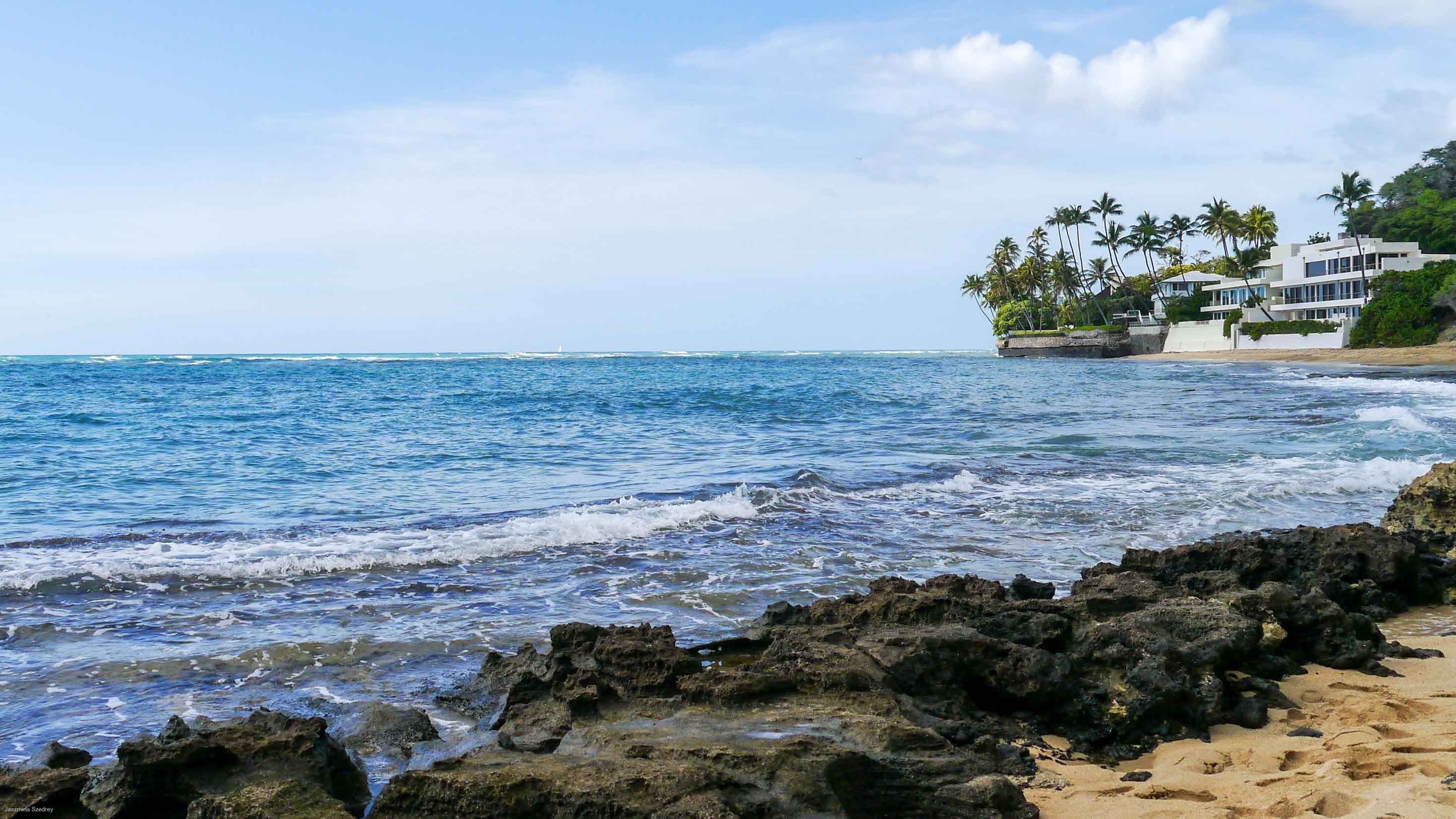
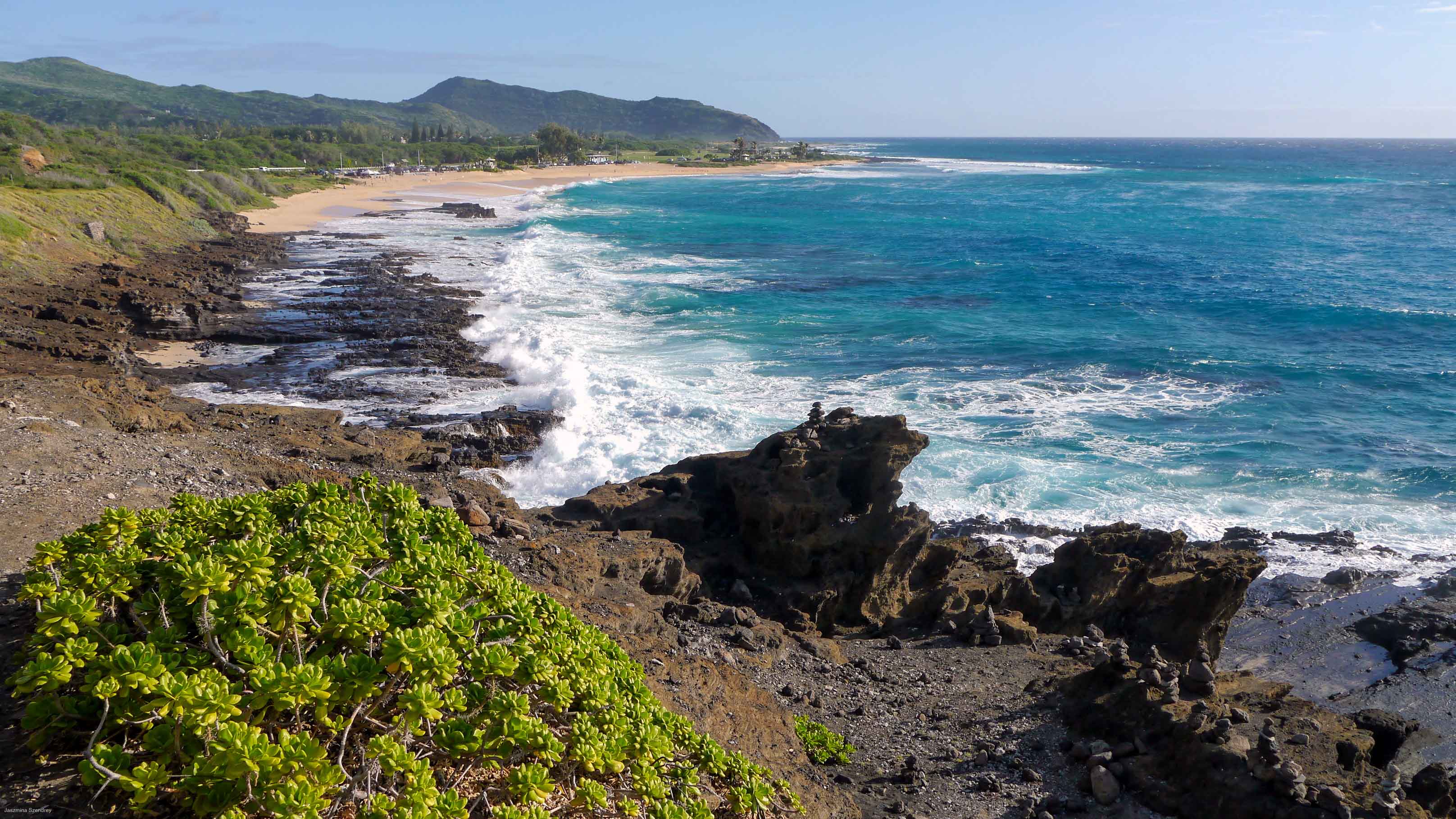
On the way to Halona Blowhole, lies Umi Mamori Jizō, a Japanese fishing shrine. In the 1800s, the first-generation Japanese fishermen of Hawaii established shrines along the East Oahu beaches for protection. Crafted from lava rock, this altar features Jizō, one of Japan’s cherished deities. Regarded as the Bodhisattva who watches over travelers’ lost souls and serves as the guardian of children, Jizō embodies a significant spiritual presence. Halona Blowhole is a vertical lava tube through which ocean waves surge, creating a captivating spectacle as they spout up. The intensity of this natural phenomenon varies depending on water conditions: at times it is barely discernible, while on other occasions, it erupts into a 9-meter geyser of seawater. Approaching the blowhole by walking on the rocks can be hazardous due to unpredictable waves that may sweep away individuals. Fortunately, a nearby trail leads down to Halona Cove, where visitors can explore a walkable lava tube while staying safe. Situated just beyond Halona Blowhole, Sandy Beach is a favorite spot among locals, renowned for its excellent bodyboarding and bodysurfing opportunities, attributed to its powerful shore break and consistent barrels. This beach stands out as one of Oahu’s most challenging, with the ocean usually heaving and thrashing like a furious beast. Dubbed the ‘beach of broken necks’ by Hawaiians, it is a somber reference to the unfortunate incidents where numerous individuals have suffered paralysis or drowned after enjoying the waves at Sandy’s. Daredevils spend hours attempting to conquer these pounding waves, achieving successful rides as a rare yet exhilarating feat.
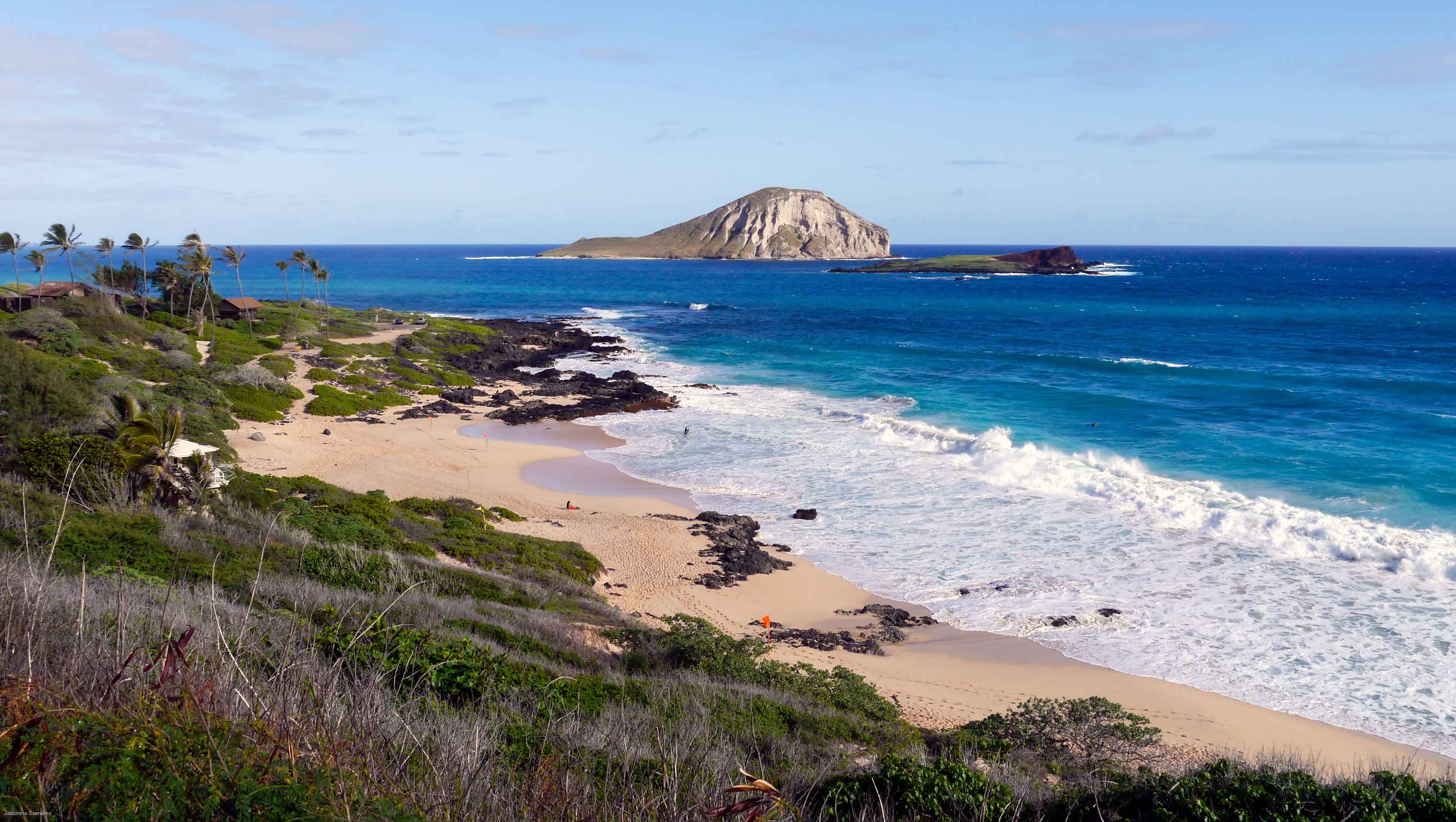
The Makapuu Point Lighthouse Trail is a gently ascending paved pathway that winds along sea cliffs. Widely regarded as a moderately challenging route, the trail covers a distance of 4 kilometers out-and-back with a 198-meter elevation gain, typically requiring about 1 hour and 23 minutes to complete. This area of the island is characterized by its hot and arid climate, evident from the abundance of prickly-pear cacti lining the trail. Initially, the trail offers outstanding views of Oahu’s southeastern coastline, including the impressive Koko Crater. On clear days, even Molokai and Lanai can be seen in the distance. Near the lighthouse, views open up to the eastern side of Oahu, revealing the Windward Coast, which is the lushest and most verdant coast, as well as offshore islets. The trail is an excellent vantage point for spotting migrating humpback whales during their season from December to May, as these gentle giants come to the warm Hawaiian waters to breed and give birth. Situated just beyond Makapuu Point, Makapuu Beach, similarly to Sandy Beach, is renowned for being an excellent spot for bodyboarding and bodysurfing, particularly among experts who can navigate its rough waters and dangerous currents. Two islands lie offshore Makapuu Beach, with Mānana being the larger one, commonly known as Rabbit Island due to its history of being inhabited by rabbits introduced in 1880. They were removed about a hundred years later because they were damaging the native ecosystem. Mānana is an extinct tuff cone with two craters, its floor honeycombed with burrows suitable for nesting. Both islands serve as wildlife sanctuaries for Hawaiian seabirds.
Located on lush 1.6 square kilometers at the foot of the majestic Koolau Mountain Range, the Hoomaluhia Botanical Garden offers a tranquil retreat. Initially designed and constructed by the United States Army Corps of Engineers to mitigate flood risks in Kāneohe, the garden was opened to the public in 1982. This rainforest oasis showcases a rich variety of plant species from major tropical regions of the world, organized into distinct geographical areas: the Philippines and Malaysia, Tropical America, India and Sri Lanka, Melanesia, Hawaii, Polynesia, and Africa. Special attention is given to preserving indigenous plants from Hawaii and Polynesia. Natura enthusiasts can wander along winding trails that meander through verdant meadows, skirt the Loko Waimaluhia reservoir, and follow alongside streams. For those desiring an overnight escape amidst the lush landscape, the garden even offers campgrounds. The nearby Valley of the Temples nestles in a similarly serene environment, with the Koolau Mountain Range providing a majestic natural backdrop. It serves as a memorial park where thousands of residents from various religious backgrounds, including Protestant, Catholic, Buddhist, and Shinto, are laid to rest. Within the park stands a replica of the 11th-century Phoenix Hall of the Byodo-In Temple complex located in Uji, Japan. It was built in 1968 to commemorate the centennial of the first Japanese workers’ arrival in Hawaii. The temple features an impressive 2.7-meter Amida Buddha statue seated atop a gold lotus leaf.
Kualoa Beach attracts large extended-family groups, often gathering here for weekend picnics. In ancient Hawaii, Oahu’s chiefs brought their children to this beach for training to become rulers and to learn about their cultural heritage. At the south end of the park lies Apua Pond, a salt marsh serving as a nesting area for some endangered birds. Offshore, the iconic island known as Mokolii Island is a prominent feature. It is popularly referred to as the ‘Chinaman’s Hat’ due to its resemblance to the traditional Chinese coolie’s hat. According to Hawaiian mythology, its creation is explained in the legend of Hiiaka, a sister of Pele, who is the goddess of the volcano.
“After Pele traveled across the Hawaiian Islands and finally made her home on the Big Island, she still wandered in her dreams as a spirit. During one of these travels, she found a handsome prince on Kaua’i, Lohi’au, and wanted to meet him personally. She asked each of her sisters to go to Kaua’i and bring him back, but they all refused, foreseeing the dangers of the trip. Finally, the youngest of the girls, Hi’iaka, agreed. On O’ahu, as Hi’iaka followed the trail on the shore of Kāne’ohe Bay, she was confronted by a mo’o, a large dragonlike creature. Using her supernatural power, Hi’iaka killed the mo’o, cut off his tail, and threw it into the ocean, where it became the island called Mokoli’i or ‘little dragon’.”
John R. K. Clark (2004) Beaches of O’ahu
While continuing towards the North Shore, travelers will come across numerous shrimp shacks like the Tanaka Kahuku Shrimp Shack, as well as fruit stands such as Kuilima Fruit Stand, lining the roadside, offering fresh local produce.
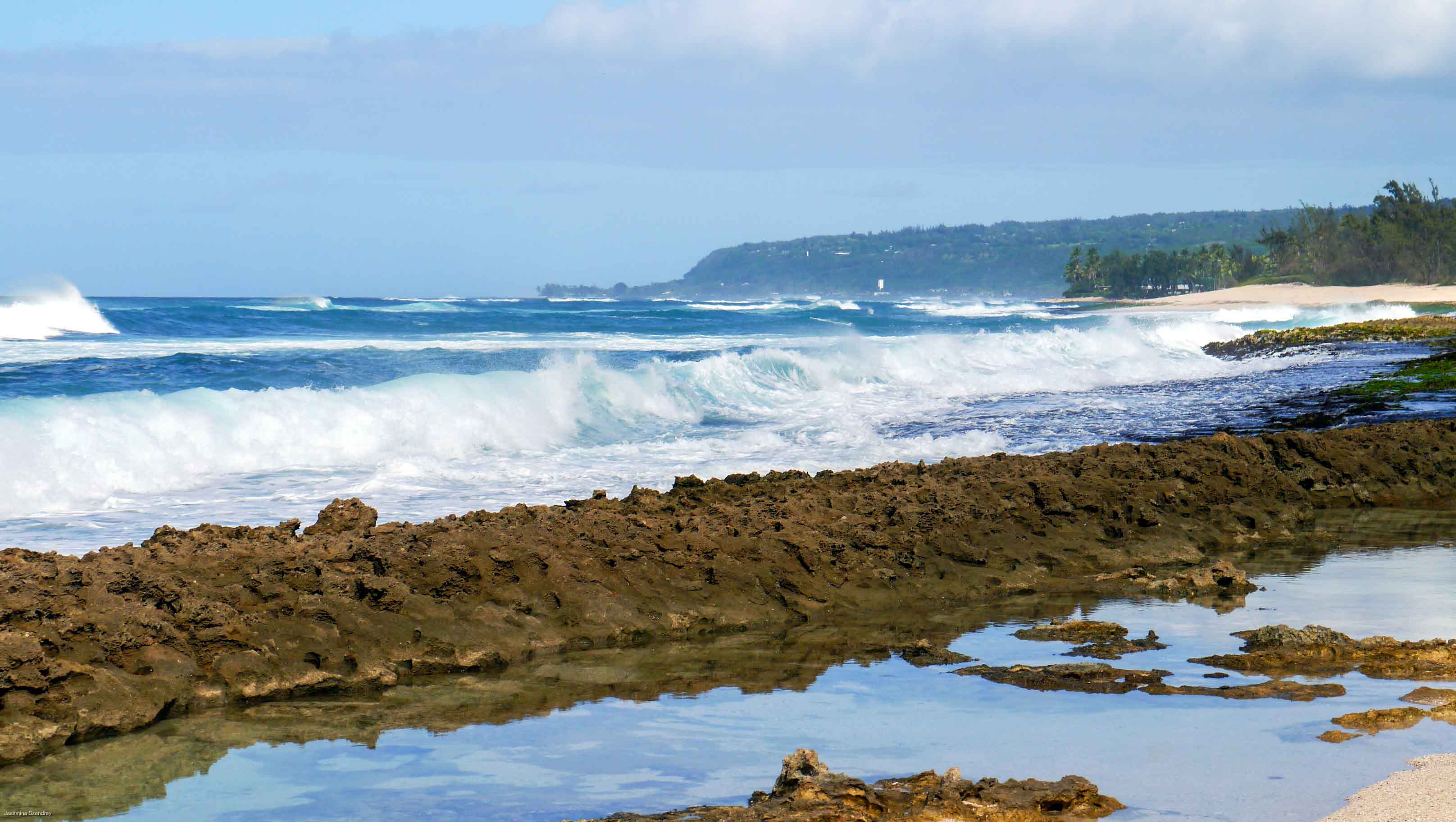
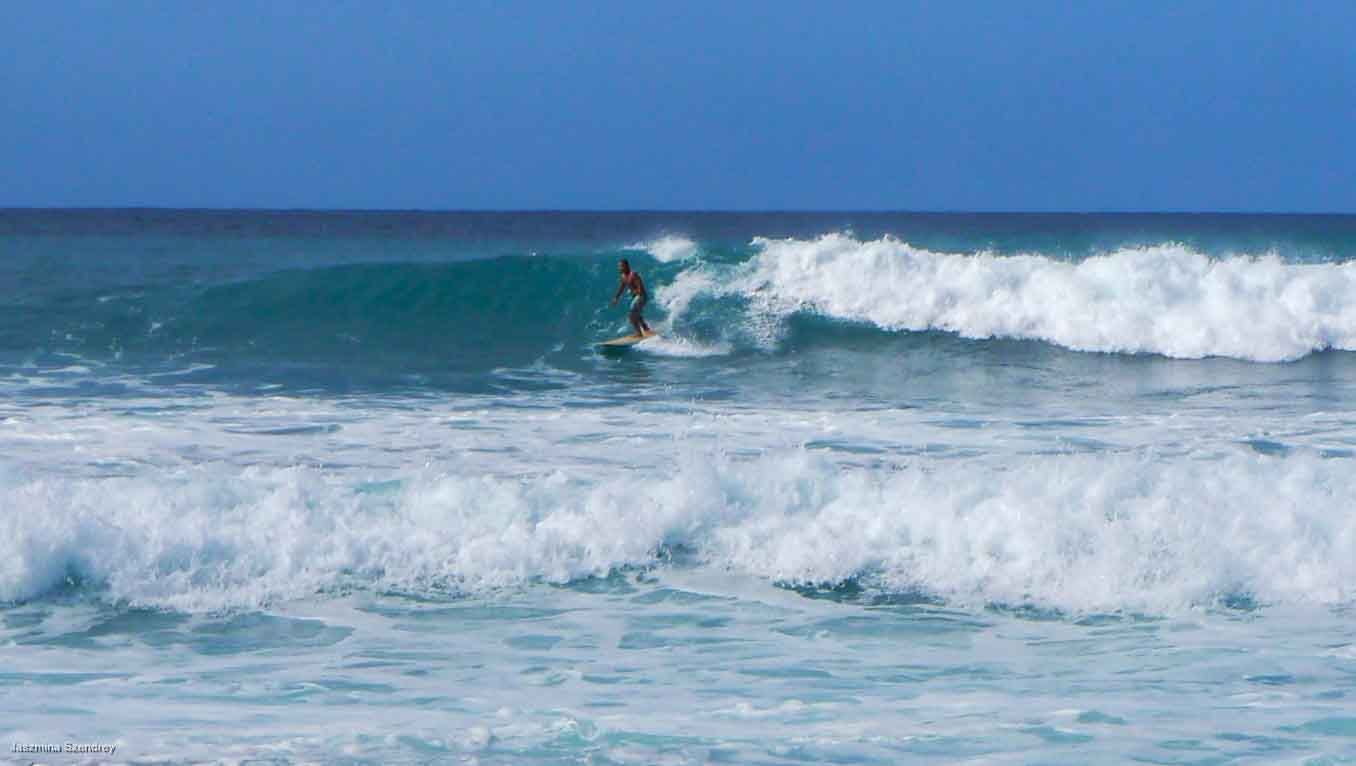
The North Shore is a stunning combination of power and beauty, featuring both barreling waves and tranquil shores. In the summer, the waves are calm, making the beaches among Oahu’s finest for swimming and snorkeling. However, winter brings epic breaks that can reach heights of 4.5 to 12 meters, attracting some of the world’s best and bravest surfers. Surfing has deep roots in Polynesian culture, dating back to 400 AD. Its modern popularization is credited to Duke Paoa Kahanamoku (1890-1968), a Hawaiian-born five-time Olympic medalist in swimming. Sunset Beach boasts one of the longest stretches of rideable surf in the world and is famous for its powerful rip current, known as the Sunset Rip, forming on large swells. During the winter months, it hosts internationally renowned surfing competitions. Shark’s Cove is a lava-rock beach, renowned for its underwater rock formations and diverse marine life, making it a favorite among snorkelers and scuba divers. Laniakea Beach, also known as Turtle Beach, is a narrow strip of sand, where Hawaiian green sea turtles frequently bask in the sun in large numbers. These turtles are protected under federal law. Kawailoa Beach features a wide sandy stretch and massive waves in winter, making it another popular surf spot. Finally, Puaena Point Beach offers a rocky, sandy shoreline with tide pools and small waves ideal for novice surfers.
Hawaii is renowned for several iconic products, each contributing to the archipelago’s culinary and agricultural heritage. Among these are macadamia nuts, pineapples, and Kona coffee. Along the roadside on the way back to Honolulu, there are opportunities to sample and purchase these local delights. Macadamia nuts, a staple snack and ingredient in various dishes, are one of Hawaii’s leading exports. The North Shore Macadamia Nut Company, known for its natural nuts, also offers an assortment of flavored varieties, each promising a unique taste experience. Hawaiian pineapples, famous for their succulent sweetness, embody the essence of the island’s tropical allure. While indulging in a Dole Whip ice cream at the Dole Plantation, visitors can also partake in various activities, such as embarking on a scenic train ride around the plantation or navigating through the Pineapple Garden Maze, which holds the Guinness World Record as the largest maze worldwide. To conclude the shopping part of the road trip with a touch of aromatic indulgence, a visit to the Green World Coffee Farms beckons, offering a variety of freshly roasted coffee options. Additionally, the farm offers a daily tour, providing a glimpse into the intricate process of coffee cultivation and production.
Pearl Harbor holds significant resonance for all Americans. The Pearl Harbor National Memorial serves as a commemoration of the events of December 7, 1941, when the Imperial Japanese Navy Air Service launched a surprise military strike against the American naval base at Pearl Harbor, marking a dark chapter in Hawaii’s history. Alternative views suggest that President Franklin D. Roosevelt (in office: 1933-1945), constrained by the American public’s opposition to direct U.S. involvement in the fight against Nazi Germany, intentionally stationed the fleet in Pearl Harbor to provoke a Japanese attack, thus leading to the United States joining the war alongside Britain. During the attack, in just over an hour, Japanese bombers inflicted severe damage on U.S. military installations: six ships were sunk, thirteen ships were damaged, 188 aircraft were destroyed, with an additional 159 aircraft damaged, and 2,403 people were killed. Japanese losses, in comparison, were relatively light. Visitors to the memorial can learn about the events leading up to and following the attack. The USS Arizona Memorial, a sunken battleship, honors the lives lost during the attack. Visitors can take a boat ride to the memorial, observe the remains of the ship, and pay their respects to the servicemen entombed within. Separate and independently managed sites, such as the Battleship Missouri Memorial, Pacific Fleet Submarine Museum, and Pearl Harbor Aviation Museum, offer additional insights into the history of Pearl Harbor. The USS Missouri Battleship, famously known as the Mighty Mo, is where the Japanese surrender documents were signed, effectively ending World War II. Although the surrender ceremony took place in Tokyo, the ship is now part of the museum and memorial complex at Pearl Harbor. The Pacific Fleet Submarine Museum showcases exhibits on submarines and their pivotal role in naval warfare. The museum’s prized exhibit, the USS Bowfin Submarine, offers a glimpse into the life of submariners during World War II. Additionally, the Pearl Harbor Aviation Museum explores the aviation history of Pearl Harbor. The exhibits that tell the story of the attack are displayed within an authentic World War II-era hangar.

Sources
https://dlnr.hawaii.gov/dsp/parks/oahu/diamond-head-state-monument
https://www.honolulu.gov/parks/hbg/honolulu-botanical-gardens/182-site-dpr-cat/569-ho-omaluhia-botanical-garden.html
https://www.valley-of-the-temples.com
https://www.nps.gov/perl/index.htm
 Trespasser-on-Earth